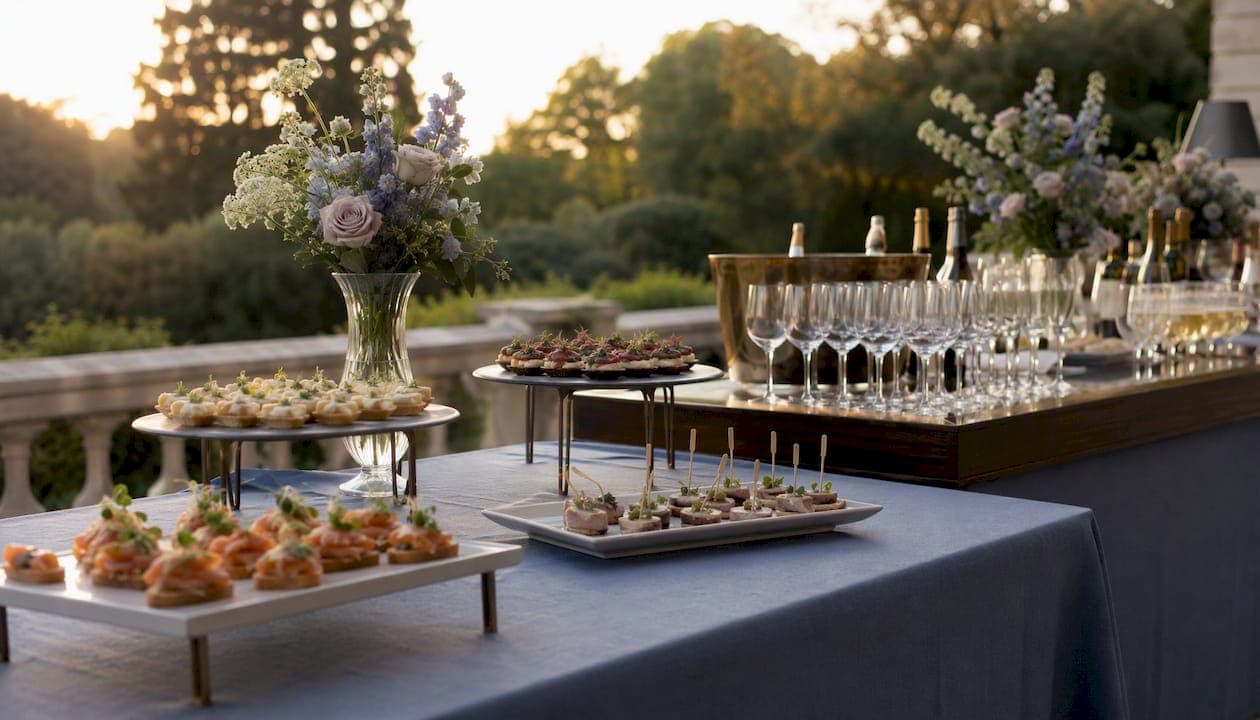
Aim for 60 minutes. That single rule covers the majority of American weddings and satisfies every major constraint at once: it gives your venue time to flip the reception room, your photographer a clean window for portraits, and your guests enough time to settle in without losing momentum.
A few quick exceptions worth knowing before you read further:
- Extend to 75–90 minutes if you skipped a first look and need the full portrait session after the ceremony, or if your guest count tops 150 and bar lines will be long
- Shorten to a shorter time if your ceremony and reception are in the same room (no venue reset needed) or if your photo list is short and you did a first look
- Cap at 90 minutes unless you have a compelling reason to go longer; most planners advise against exceeding that because guest energy drops noticeably after the 90-minute mark
Pro Tip: Build your cocktail hour length around your photographer's needs first, then adjust for venue logistics. Photos are the one element you can't redo.
Key Takeaways
The standard cocktail hour length is 60 minutes, extendable to 90 minutes when photography, guest count, or venue logistics genuinely require it.
| Point | Details |
|---|---|
| Standard length is 60 minutes | Covers venue reset, portrait session, and guest arrival for most U.S. weddings. |
| Extend to 75–90 minutes when needed | Large guest counts, no first look, or long travel between ceremony and reception justify the extra time. |
| Cap at 90 minutes | Beyond 90 minutes, guest energy drops; plan structured entertainment if you must go longer. |
| Music sets should run 10 minutes long | Plan 70 minutes of material for a 60-minute cocktail hour to prevent awkward silences. |
| Alexlevinmusic matches ensemble to length | Solo piano fits 45–60 minutes; a jazz trio covers 60–90 minutes with real-time set flexibility. |
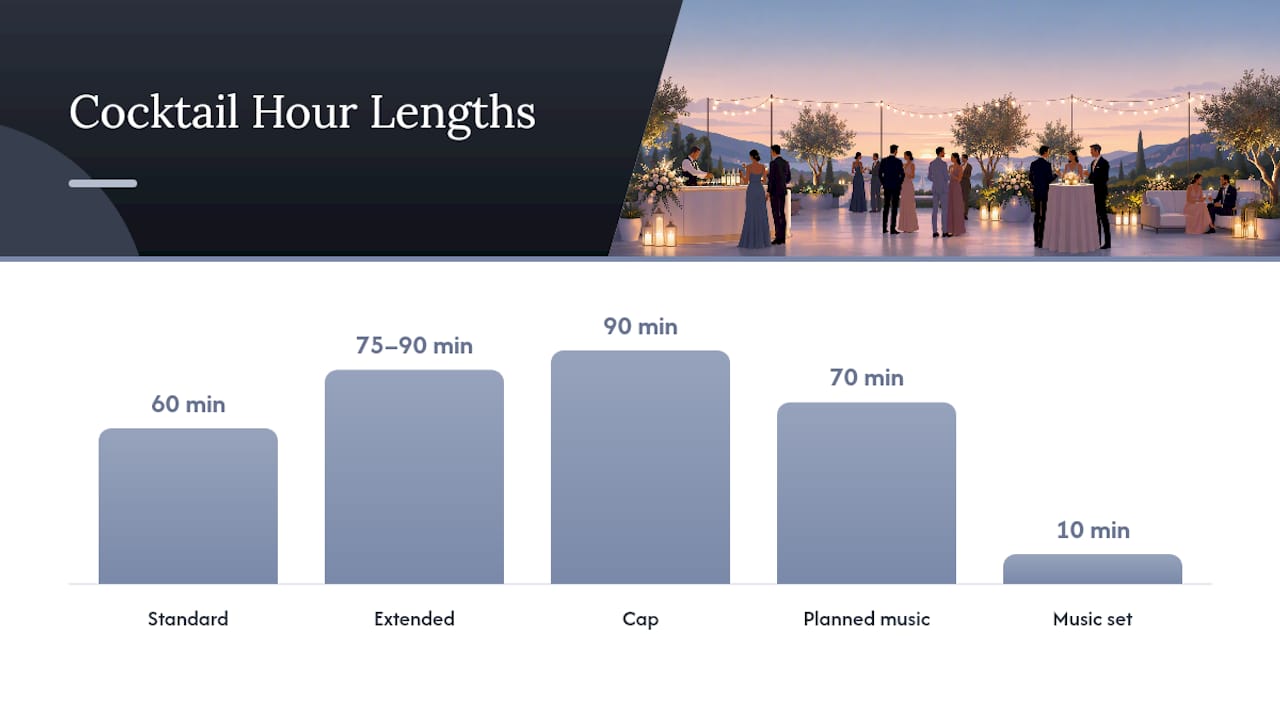
Table of Contents
- What cocktail hour length fits your wedding situation?
- What factors should actually determine your cocktail hour duration?
- Sample timelines you can copy and adapt
- How does your entertainment choice affect cocktail hour flow?
- How food and bar service affect how long cocktail hour should run
- What to do when the cocktail hour timeline shifts on the day
- Is 2 hours too long? Is 45 minutes too short? Common rules explained
- What a professional musician knows about cocktail hour timing
- The trade-off no planning guide will make for you
- Live music for your cocktail hour from Alexlevinmusic
- Sources
What cocktail hour length fits your wedding situation?
The 60-minute standard exists for good reason, but it isn't universal. Here's how each common duration maps to real wedding scenarios:
45 minutes works when the ceremony and reception happen in the same space, the venue reset is minimal, and you completed a first look before the ceremony. Guests barely have time to grab a drink and say hello, so this only works when the day is already running tight and the couple is ready to enter reception quickly.
60 minutes is the traditional and most widely recommended length. It accommodates a standard portrait session, a typical venue flip, and a comfortable guest arrival window. Most U.S. venues price their packages around this assumption, and most caterers staff for it.
Longer durations suit weddings where the ceremony and reception are in separate buildings or where the couple skipped the first look and needs extended portrait time. It also helps when you have a large bridal party requiring group photos that run long.
90 minutes makes sense for large weddings (200+ guests), venues with complex resets, or situations where significant travel separates the ceremony from the cocktail space. Most planners set 90 minutes as the practical ceiling because beyond that, guests start to feel like they're waiting rather than celebrating.
Extended durations are rarely recommended and should only happen when the schedule genuinely demands it, such as an outdoor ceremony far from the reception venue with shuttle logistics involved. Even then, plan structured entertainment and food stations to keep energy up, not just an open bar.
What factors should actually determine your cocktail hour duration?
The real answer isn't a fixed number; it's your logistics. Work through this checklist before you commit to a length:
- Travel distance between spaces. If guests walk 90 seconds from ceremony to cocktail area, you need less buffer. If they're shuttling 20 minutes to a separate venue, build that into your calculation.
- Photography timeline. Did you do a first look? A first look compresses the post-ceremony portrait window significantly. No first look means you need at least 60 minutes, often 75, to complete family formals, wedding party shots, and couple portraits.
- Guest count and bar capacity. Large guest counts with limited bar stations can cause lines. Guests stuck in line aren't socializing, and they notice. More guests generally mean more time may be needed.
- Venue reset requirements. Some venues need 45 minutes to flip a ceremony room into a reception space. Others are pre-set. Confirm this with your venue coordinator before you finalize anything.
- Noise curfews and venue restrictions. Outdoor venues especially may have hard stop times that compress your entire evening. Work backward from the curfew, not forward from the ceremony.
- Entertainment format. A live band needs load-in and sound check time that a DJ doesn't. A solo pianist can set up in 20 minutes; a jazz trio needs closer to 45. Factor that into your cocktail hour start time.
- Budget. Every extra 30 minutes of cocktail hour adds staffing hours, bar consumption, and potentially musician fees. A 90-minute cocktail hour can cost meaningfully more than a 60-minute one when you add it up across catering, bar, and entertainment line items.
Pro Tip: Use a free event planning checklist to map every vendor's arrival and departure time before you lock in your cocktail hour length. Conflicts show up fast when everything is on one page.
Sample timelines you can copy and adapt
These five timelines show how cocktail hour length ripples through the whole day. Each one reflects a different wedding scenario with a different set of constraints.
| Wedding type | Ceremony ends | Cocktail start | Cocktail end | Reception start |
|---|---|---|---|---|
| Small city wedding, first look done | 4:00 PM | 4:10 PM | 5:00 PM | 5:00 PM |
| Large hotel wedding, no first look | 4:00 PM | 4:15 PM | 5:45 PM | 5:45 PM |
| Outdoor venue, 20-min shuttle | 3:30 PM | 4:00 PM | 5:30 PM | 5:30 PM |
| Late-afternoon ceremony, tight curfew | 5:30 PM | 5:45 PM | 6:30 PM | 6:30 PM |
| Same-room flip, minimal reset | 3:00 PM | 3:00 PM | 3:50 PM | 4:00 PM |
A few notes on why each timeline uses that specific length:
- The small city wedding runs a tight 50-minute cocktail hour because the first look already handled couple portraits. The photographer uses cocktail hour for candid guest shots only.
- The large hotel wedding stretches to 90 minutes because 200+ guests need time to filter through the bar, and the couple needs a full portrait session post-ceremony.
- The outdoor shuttle wedding builds in 30 minutes of travel time before cocktail hour even starts, then runs a full 90-minute window to accommodate late arrivals from the shuttle.
- The late-afternoon ceremony keeps cocktail hour to 45 minutes because a 10:00 PM venue curfew compresses everything downstream.
- The same-room flip runs 45 minutes because the venue reset is the only real constraint; photos were done before the ceremony.
Where to add buffer: put 10 extra minutes between ceremony end and cocktail start (ceremonies almost always run a few minutes long), and add 5 minutes before the reception entrance to gather the wedding party.
How does your entertainment choice affect cocktail hour flow?
Music format changes the practical experience of cocktail hour more than almost any other variable. A 60-minute cocktail hour with a live jazz trio feels shorter than a 60-minute one with a Spotify playlist, because live music gives guests something to pay attention to between conversations.
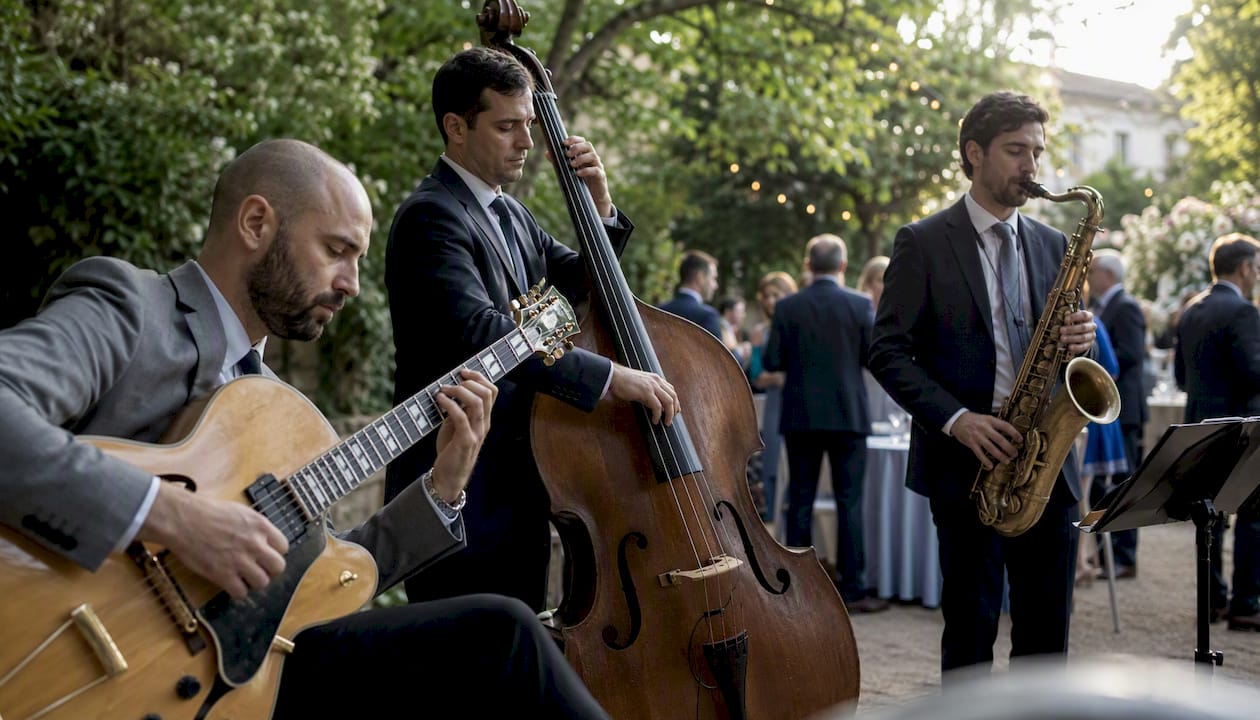
Solo piano or solo guitar suits a 45–60-minute window perfectly. Setup is fast (15–20 minutes), the sound is intimate, and the repertoire can shift from background to slightly more present without disrupting conversation. It's the right call for smaller guest counts and tighter spaces.
A jazz duo or trio works best in the 60–75-minute range. The ensemble creates more energy and fills a larger space naturally. Setup takes 30–45 minutes, so coordinate your musician's arrival at least an hour before cocktail hour starts. A trio playing jazz standards or bossa nova sets exactly the tone that professional planners recommend for bridging ceremony formality and reception energy.
A DJ offers the most flexibility on set length and can adjust in real time if the schedule shifts. The tradeoff is atmosphere: a DJ running background music during cocktail hour rarely creates the same sense of occasion as a live ensemble. If you're using a DJ for the reception, consider pairing them with a live soloist during cocktail hour for the best of both.
Regardless of format, plan your playlist or set list about 10 minutes longer than your scheduled cocktail hour. If you're running a 60-minute cocktail hour, your musician or DJ should have 70 minutes of material ready. For a 60-minute slot, that means roughly 20–25 songs. The extra material covers real-world delays and prevents the awkward silence that happens when music runs out before guests move to the reception.
Pro Tip: Give your musician or DJ a specific cue, not a time, to signal the reception entrance. "Play one more song after the coordinator gives you the thumbs-up" is more reliable than "wrap up at 5:45 PM."
For more on how live music shapes the cocktail hour atmosphere, the cocktail hour soundscapes guide covers repertoire and mood in detail.
How food and bar service affect how long cocktail hour should run
Food service style and cocktail hour length are directly linked. Choose the wrong combination and you'll either run out of food before guests are seated or have a spread sitting untouched because the hour ended too quickly.
Passed hors d'oeuvres work best for 45–75-minute cocktail hours. The standard expectation in U.S. catering is roughly 4–6 passed bites per guest per hour. For a 60-minute cocktail hour with 100 guests, that means planning for 400–600 individual pieces. Staffing typically runs one server per 25–30 guests for passed service.
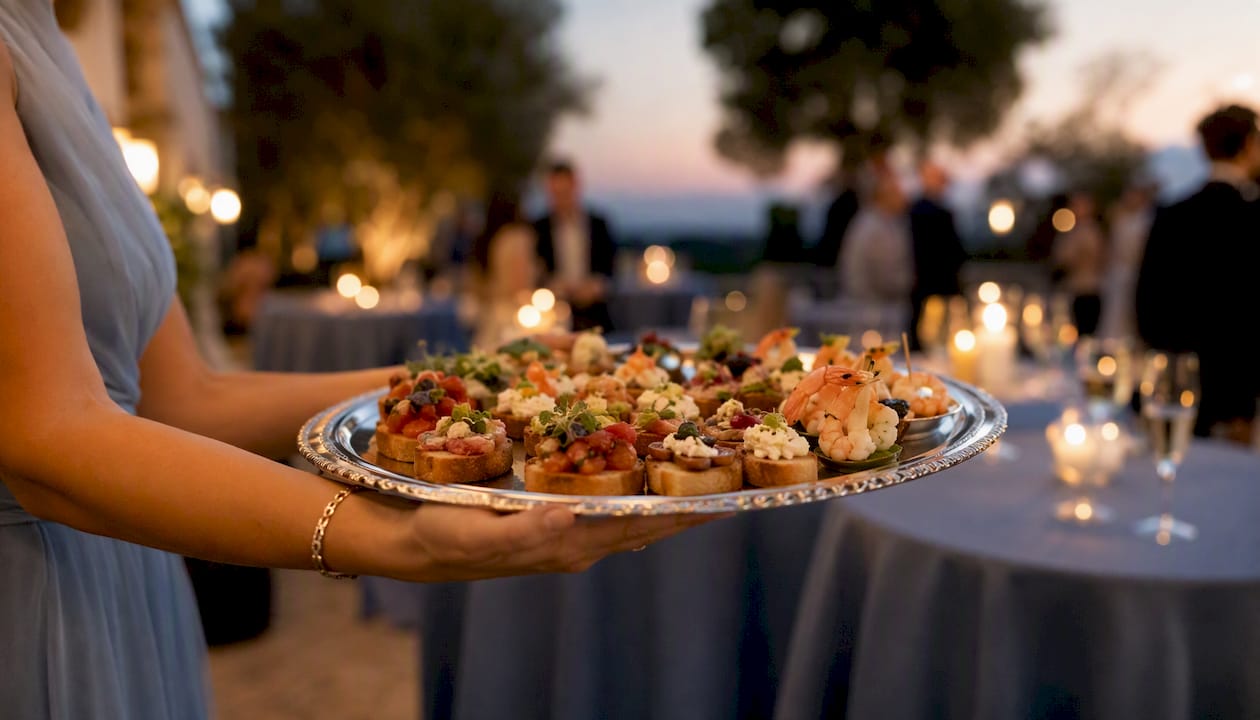
Food stations need more time to justify the setup cost and to let guests actually visit them. A 60-minute minimum is realistic; 75–90 minutes is better. Stations also reduce the pressure on bar lines because guests are moving around the room rather than clustering in one spot.
Buffet-style cocktail hour is less common but occasionally used for very large guest counts. It requires the most space and the longest window, typically 75–90 minutes, to avoid bottlenecks.
On the bar side, open bar pricing at U.S. venues is almost always structured per person per hour. Every 30 minutes you add to cocktail hour increases your bar tab proportionally. If your venue charges on a consumption basis rather than a flat package, a 90-minute cocktail hour with 150 guests can add several hundred dollars compared to a 60-minute one. Confirm the pricing structure with your caterer before you decide on length.
A guest list manager that tracks confirmed RSVPs helps you give your caterer an accurate headcount for staffing and food quantity calculations, which directly affects how smoothly service runs regardless of cocktail hour length.
What to do when the cocktail hour timeline shifts on the day
Ceremonies run long. Photographers need one more shot. Shuttle buses are late. When the schedule slips, here's the order of operations:
- Tell your band or DJ first. They can extend their set without any visible disruption to guests. A live musician adding one more song buys you 4–5 minutes invisibly.
- Notify the catering captain. If cocktail hour is running long, passed hors d'oeuvres need to keep circulating. If it's being cut short, the kitchen needs to know so the dinner course timing adjusts.
- Alert your photographer. If you're cutting cocktail hour short, they need to know which shots to prioritize and which to drop. Family formals before couple portraits, always.
- Tell your emcee or coordinator. They control the guest-facing timeline. A brief, cheerful announcement ("We're having such a great time we're giving you a few extra minutes!") keeps the energy positive.
- Adjust the reception entrance time. Push it, don't rush it. A rushed entrance feels chaotic; a slightly delayed one with good music playing feels like anticipation.
What can be shortened without guests noticing: the gap between cocktail hour end and reception entrance (guests are already standing and ready), the number of passed hors d'oeuvres rounds, and the emcee's opening remarks.
What cannot be shortened without consequences: the venue reset (they need what they need), the photographer's family formal list (cutting names creates hurt feelings), and the bar service (guests notice immediately).
Pro Tip: Give your coordinator a 10-minute "flex window" built into the printed timeline that no vendor sees. It's your private buffer for exactly these moments.
Is 2 hours too long? Is 45 minutes too short? Common rules explained
Is 2 hours too long? Usually, yes. Going beyond 90 minutes is generally not recommended because guests lose momentum and the transition into dinner feels anticlimactic. Two hours works only with structured entertainment, multiple food stations, and a compelling reason (long shuttle logistics, for example). Without those, guests start checking their phones around the 75-minute mark.
Is 45 minutes too short? Not always. For a small wedding where the couple did a first look, the ceremony and reception are in the same venue, and the guest count is under 75, 45 minutes is plenty. The problem is that 45 minutes leaves almost no buffer for real-world delays. Most planners recommend 60 minutes as the floor precisely because something almost always runs a few minutes long.
The 30-5 rule: Some planners use a simple rule of thumb: plan 30 minutes of cocktail hour for every 50 guests, with a minimum of 60 minutes. A 100-guest wedding gets 60 minutes; a 200-guest wedding gets 75–90 minutes. It's a rough guide, not a formula, but it scales reasonably well.
The proportions shift based on your specific setup, but the framework helps when you're trying to justify a length to a skeptical venue coordinator.
For edge cases: if your venue has a hard curfew that compresses the evening, work backward from that curfew and protect dinner and dancing time first. Cocktail hour is the most flexible part of the timeline and the easiest to trim without guests feeling shortchanged, as long as food and drink service stays consistent.
What a professional musician knows about cocktail hour timing
From a musician's perspective, cocktail hour is the most technically demanding part of a wedding to play well, not because the music is hard, but because the timing is unpredictable and the room is never fully settled.
Here's what changes based on ensemble size:
- Solo piano or guitar: 15–20-minute setup, no amplification needed in most indoor spaces under 100 guests, repertoire should lean toward recognizable but not distracting (jazz standards, light classical, bossa nova)
- Duo (piano + bass, or guitar + vocals): 25–35-minute setup, light amplification typically needed, can handle rooms up to 150 guests comfortably
- Jazz trio: 35–50-minute setup, full PA required, fills a large ballroom or outdoor tent without feeling overwhelming, ideal for 60–90-minute cocktail hours with 100–250 guests
- String quartet: 20–30-minute setup, no amplification needed, carries a formal register that suits ceremony-to-cocktail transitions beautifully
Practical booking checklist for any live ensemble:
- Confirm call time at least 60 minutes before cocktail hour starts (90 minutes for trios and larger)
- Verify power outlet access and proximity to the performance area
- Provide a specific end cue, not just an end time
- Share the reception entrance song so the musician can build toward it naturally
- Confirm whether the musician plays during the reception entrance or stops when guests are called in
Pro Tip: Ask your musician to play one song that's slightly more upbeat and recognizable in the final 10 minutes of cocktail hour. It signals to guests that something is about to happen and naturally draws the room together before the reception entrance.
The cocktail party musician hiring guide covers these logistics in more detail, including what to put in your musician contract.
The trade-off no planning guide will make for you
Every cocktail hour length decision comes down to one honest question: what matters most to you on this specific day?
If portraits are non-negotiable, protect 75–90 minutes and accept that bar costs go up. If budget is the binding constraint, a tight 60-minute cocktail hour with passed hors d'oeuvres and a solo musician is genuinely elegant and costs significantly less than a 90-minute spread with stations. If your guests are traveling from out of town and need time to find the venue, park, and decompress, give them 75 minutes and don't feel guilty about it.
The mistake most couples make isn't choosing the wrong length. It's choosing a length without telling their vendors why, which means every vendor optimizes for their own default instead of the couple's actual priority. Tell your photographer how long you have. Tell your caterer whether you're prioritizing guest comfort or cost control. Tell your musician whether you want the cocktail hour to feel like a party or a prelude.
When those conversations happen before the wedding day, the timeline holds. When they don't, everyone improvises, and improvisation at a wedding is rarely as charming as it sounds.
Live music for your cocktail hour from Alexlevinmusic
The right cocktail hour length only works when the music fills it properly. Alexlevinmusic offers ensemble options that map directly to your timeline: solo piano for a 45–60-minute window, a jazz duo or trio for 60–90 minutes, and fully flexible set lengths that adjust in real time when the schedule shifts.
Every booking includes repertoire consultation, vendor coordination support, and a musician who knows how to read a room and cue the reception entrance without an announcement. Setup logistics, power requirements, and call times are handled upfront so your coordinator isn't troubleshooting on the day. Alexlevinmusic serves weddings in Philadelphia, New York, and surrounding areas.
To match the right ensemble to your cocktail hour length and venue, start with a consultation or browse available packages at Alexlevinmusic.
Sources
These are the primary references used throughout this guide. Each one covers a specific aspect of cocktail hour planning worth reading in full:
- Cocktail Hour: Your Official How to Plan Guide
- How Long Is Cocktail Hour? The Power of Happy Hour
- How Long Should a Cocktail Hour Be? | Wedding Spot Blog
- How Long Should Cocktail Hour Be? (And What Most Weddings Get Wrong)
- What Is Cocktail Hour at a Wedding and Do You Need One?
- Cocktail Hour Wedding Explained: Timeline, Drinks, Flow