
A certificate of insurance (COI) is a one-page document that proves you carry liability coverage. It is not the policy itself, just evidence of it. Most U.S. venues want general liability coverage at a level commonly seen as sufficient and expect to be listed as an additional insured on that certificate. If you do not have a policy yet, the fastest fix is a single-event policy or an instant COI ordered online, often issued the same day.
TL;DR:
- Most venues require a general liability coverage of at least one million dollars per occurrence and need the venue listed as an additional insured with proper endorsements.
- A COI must accurately include the insured's name, policy type, coverage limits, active dates, venue details, and event description to be accepted; even one mismatch can cause rejection.
- Requesting the venue as an additional insured requires specific endorsement language, which must be clearly communicated to your insurer or COI provider beforehand.
- Single-event policies and instant COI services enable quick coverage, but longer lead times are necessary for complex endorsements or larger events involving alcohol or outdoor stages.
- Proper preparation, including verifying all details against the contract language, can prevent last-minute rejections and ensure compliance with venue insurance requirements.
Table of Contents
- What a Certificate of Insurance Actually Covers
- What Coverage Limits and Contract Wording Should You Expect?
- Should You Get an Annual Policy or a Single-Event Policy?
- How Do You Request a Venue-Approved COI on the First Try?
- How Long Does a COI Take and What Does It Cost?
- What COI Mistakes Get Bookings Rejected?
- How Alex Levin Music Handles COI Requirements for Bookings
- Book Alex Levin Music and Skip the Insurance Back and Forth
- Sources
What a Certificate of Insurance Actually Covers
A COI is a summary sheet your insurer or broker sends to the venue. It confirms you have an active policy, lists your coverage limits, and names the venue as the certificate holder. The policy itself, sometimes dozens of pages long, spells out exclusions and conditions. The COI is the two-minute version a venue manager actually reads before signing off on your load-in time.
Venue staff and event coordinators typically scan a COI for six specific fields:
- Named insured: your legal name or your band's registered business name, matching what's on your contract.
- Policy type: usually commercial general liability, sometimes with a professional liability add-on.
- Policy limits: the per-occurrence and aggregate dollar amounts.
- Policy period: the dates your coverage is active, which must span the gig date.
- Certificate holder: the venue's exact legal name and address, not a nickname or shortened version.
- Description of operations: the event name and a line describing the performance itself.
A single missing or mismatched field is the number one reason venues bounce a COI back for revision. A sample requirements document from Moose International shows exactly how granular these checks get, down to spelling the venue's name the way it appears on the lease.
Here's the part that trips up a lot of performers: a COI by itself doesn't automatically add the venue as an additional insured. That protection has to be built into your underlying policy through an endorsement, and the COI simply reflects that it exists. Without the endorsement, the certificate is essentially decorative. It shows you have insurance, but not that the venue is protected under it, which is usually the entire point of the request.

What Coverage Limits and Contract Wording Should You Expect?
Most U.S. venues set their floor at a million-dollar level per occurrence in general liability, often paired with a multimillion aggregate limit across the policy period. That level shows up consistently across contracts, from small clubs to hotel ballrooms, and larger venues, arenas, or gigs involving alcohol service frequently require higher limits with no aggregate cap.
Two phrases show up in almost every venue insurance clause, and both matter more than they sound:
- Primary and non-contributory: this means your policy pays out first, before the venue's own insurance gets touched, and the venue's coverage isn't reduced by contributing alongside yours.
- Waiver of subrogation: this means your insurer gives up its right to sue the venue after paying a claim, even if the venue was partly at fault.
Neither of these happens automatically. Both require specific endorsements added to your policy, and a broker can usually add them for a modest fee if they aren't already included in your base coverage.
Outdoor stages, large crowds, and alcohol service change the math. A rooftop cocktail hour with 300 guests and an open bar carries different risk than a quiet trio playing a living room ceremony, and insurers price that difference into premiums and sometimes into required limits. Kelly Insurance Group's guidance on concert-level certificates notes that mismatched contract terms, not missing coverage, cause most compliance headaches at bigger events.
Pro Tip: Read the venue's insurance clause before you call your insurer, not after. If the contract specifically says "primary and non-contributory" or "waiver of subrogation," repeat that exact phrase to your broker. Paraphrasing it risks getting a certificate that technically satisfies your policy but not the venue's contract.
Should You Get an Annual Policy or a Single-Event Policy?
Musicians generally have three paths to a venue-ready COI, and which one fits depends on how often you perform and how far ahead you can plan.
- Annual musician liability policy. This suits working bands and solo performers who play regularly. You pay once a year and can generate a fresh COI for each new venue without buying new coverage every time. InsuranceCanopy's musician insurance program and K&K's Bands and Performing Groups program both build around this model, and the logistics advantage compounds fast once you're booking multiple venues a month.
- Single-event policy. This fits musicians who play occasionally and don't want to pay for year-round coverage. You buy protection for one specific date, get your COI, and the policy expires after the gig. It costs more per performance than annual coverage but far less than carrying insurance you rarely use.
- Instant COI services. Providers like Thimble let you buy coverage and download a certificate within minutes, often from a phone. This works well for last-minute bookings, though instant platforms can be less flexible when a venue demands unusual endorsement wording, since that sometimes needs a broker's manual review.
Whichever path you choose, requesting the additional insured endorsement is a separate ask from just buying the policy. Tell your insurer or the instant-COI platform explicitly that you need the venue added as an additional insured, and give them the venue's exact legal name. Some platforms build this into the checkout flow; others require a follow-up request through a client dashboard, similar to the certificate request tools some specialty music insurers offer directly to policyholders.
How Do You Request a Venue-Approved COI on the First Try?
Getting it right the first time saves you a scramble two days before a gig. Pull together this information before you contact anyone:
- The venue's exact legal name and mailing address, copied directly from the contract, not typed from memory.
- The specific coverage limits the venue requires, in writing, from the contract or rental agreement.
- Any required endorsement language, such as "primary and non-contributory" or "waiver of subrogation."
- Full event dates, including setup and breakdown days if you'll be on site outside the performance window itself.
- Proof of liquor liability coverage, if the venue serves alcohol and requires it separately from general liability.
Once you have that checklist filled in, send it as a direct request rather than a vague "can I get insurance" message. Something like this works well with a broker or an instant-COI provider:
That level of detail turns a back-and-forth email chain into a same-day certificate in most cases.
Before you forward anything to the venue, check the COI against the contract line by line. Confirm the certificate holder name is spelled exactly right, the dates cover your full time on site, and the endorsement wording matches what the contract demands. A five-minute check now beats a rejected certificate the morning of the gig.
How Long Does a COI Take and What Does It Cost?
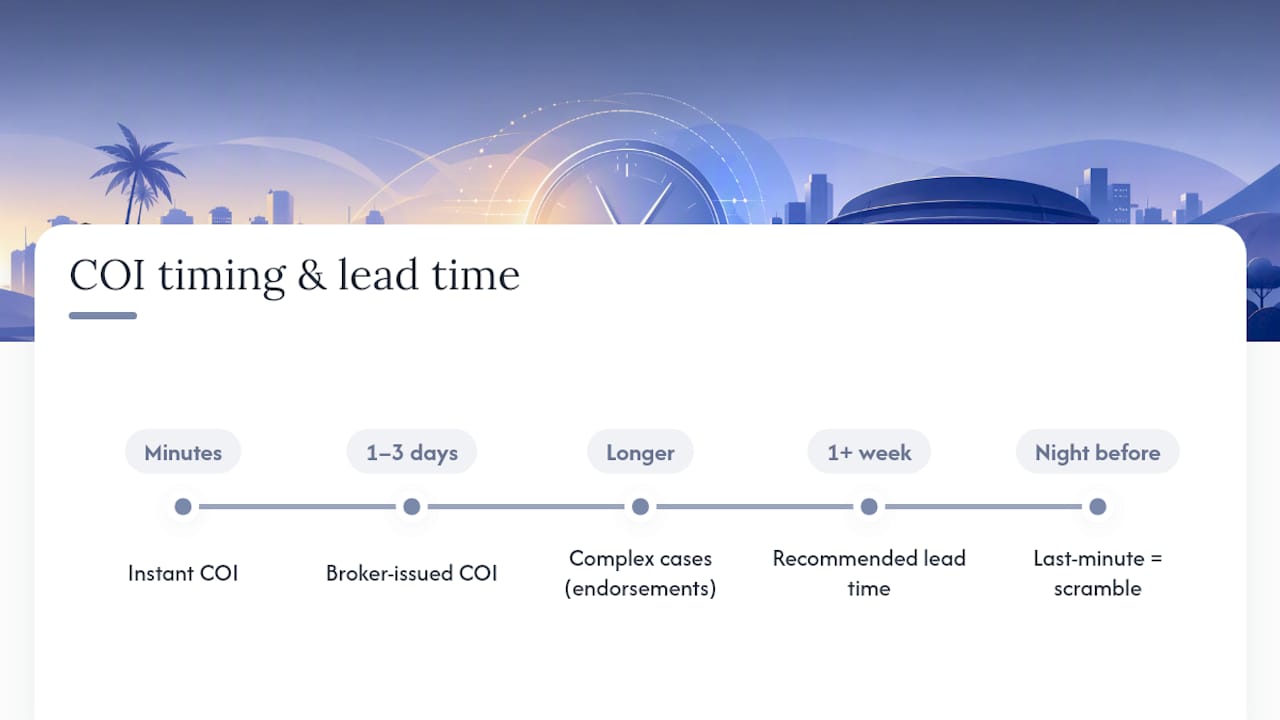
Instant-COI platforms typically issue a certificate within minutes of purchase. Broker-issued certificates, especially ones requiring custom endorsement wording, usually take one to three business days, longer if the venue's language is unusual or the underwriter needs to review it manually.
Pricing varies by coverage type and provider, but single-event musician liability policies commonly cost in ranges seen for standard gigs, while annual policies cost more upfront but eliminate per-event purchases entirely. Alcohol service, pyrotechnics, large outdoor stages, or crowds over a few hundred people tend to push premiums higher and can slow underwriting, since insurers want more detail before approving coverage.
Give yourself at least a week of lead time before a gig, longer if the venue has unusual contract language. Waiting until the night before all but guarantees a scramble.
What COI Mistakes Get Bookings Rejected?
Most rejected certificates come down to a handful of repeat offenders, and every one of them is fixable within a day if you catch it early.
- Wrong or misspelled certificate holder name. Fix it by copying the name character for character from the signed contract, not a booking email.
- Dates that don't cover setup or breakdown. Ask your insurer to extend the policy period to include load-in and load-out days, not just the performance itself.
- Missing additional insured endorsement. This is an add-on, not a default. Call your insurer and specifically request it by name.
- Limits below what the contract requires. Increasing a limit usually means a quick policy adjustment and a small premium bump, not a new application.
Pro Tip: If a corrected COI won't be ready before your call time, ask the venue coordinator directly whether they'll accept a pending certificate with a written commitment that the final version arrives within 24 hours. Most venues have seen this before and will work with you if you're upfront about it instead of showing up empty-handed.
How Alex Levin Music Handles COI Requirements for Bookings
When a venue sends over its insurance requirements, we treat it the same way we treat load-in times or sound check windows: a logistics detail that gets nailed down early, not scrambled over the week of the event. Our booking coordination process includes collecting the venue's exact certificate language and passing it along so nothing gets lost in translation between the client, the venue, and the insurer.
We've worked with enough ballrooms, private estates, and corporate venues to know that a wedding venue's insurance clause rarely reads like a hotel's. That's part of what we walk through when a client asks how booking actually works from first call to final encore.
We'll be adding specific client feedback and case notes on this process here as they become available.
— Alex
Book Alex Levin Music and Skip the Insurance Back and Forth
A live performance provider cannot issue your COI themselves. What can help is coordinating with the venue to identify exactly what their insurance clause requires, then relaying that information clearly so your insurer or an instant-COI service can produce a certificate that actually matches the contract the first time.
That kind of coordination matters most for weddings and corporate events, where multiple vendors, the venue, and sometimes a planner are all touching the same contract. If you're booking live music for a wedding or a corporate event, we handle the performance logistics end to end, including flagging insurance requirements early enough that you're not chasing a certificate the week of the show. Check availability and get a quote through our booking page to start the conversation.
Sources
For a real sample of the fields a venue expects filled in, Moose International's example certificate is worth a look before you contact your insurer. Eventure Insurance's COI guidance covers additional insured endorsements in plain language, and InsuranceCanopy's explainer for musicians answers common questions about reusing an annual COI across multiple gigs. For event insurance basics outside the music context, Liquid Courage's Las Vegas event insurance guide walks through similar limit and wording requirements. Always cross-check any sample against your specific venue contract before sending a request to your insurer.
- Hip Hop Concert Certificate of Insurance - Kelly Insurance Group
- Musician Insurance (Instant COI) | InsuranceCanopy
- Bands and Performing Groups — K&K Insurance
- DJ & Musician Liability Insurance | Instant COI by Thimble