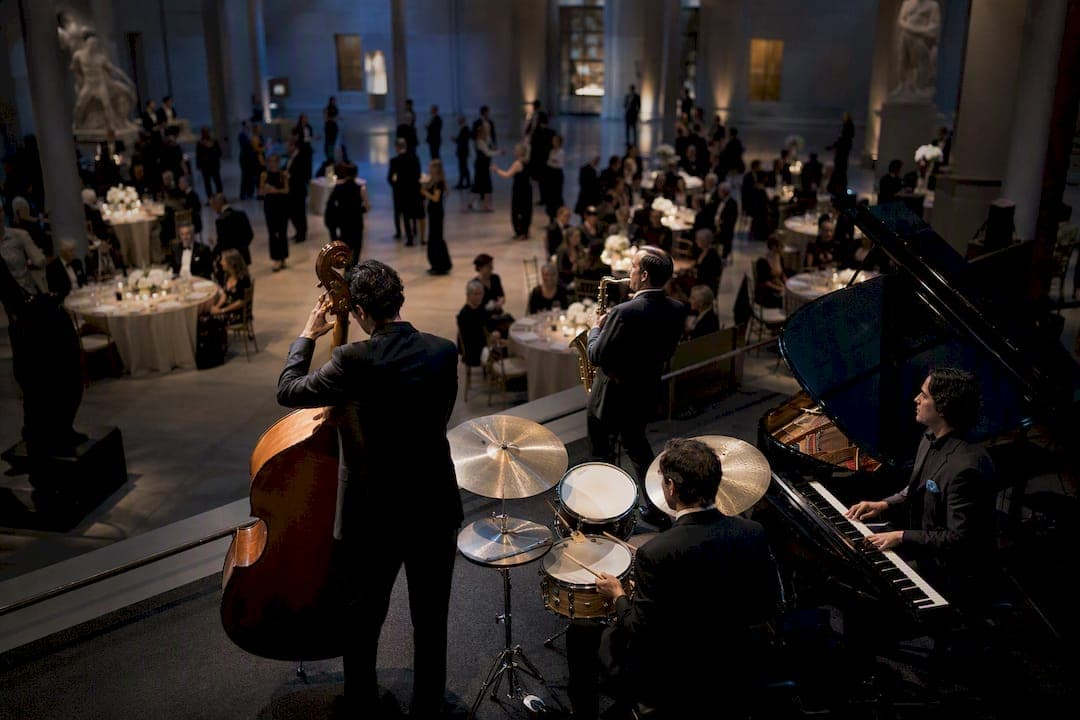
Boutique event music is a curated live-music service, ranging from a lone violinist to a full jazz quartet and DJ hybrid, built to shape a specific moment rather than fill silence. It works because a trained ensemble reads the room and adjusts on the fly, something a preset playlist can never do. It fits three moments best: the ceremony, the cocktail hour, and the reception. If you're booking for any of those, start requesting samples and dates now, since the best players fill their calendars fast.
TL;DR:
- Boutique event music offers live, adaptable performances tailored to each event phase, significantly enhancing guest experience and social media content.
- For ceremonies, smaller ensembles like solo guitar or harp are ideal for intimate venues, with larger groups necessary for grand, echo-heavy spaces.
- Cocktail hour music should be at conversation level, with 60-90 minute sets, and hybrid setups recommended for extended periods.
- Reception planning involves phased music to support dinner, toast, and dance segments, with live DJ and band hybrid setups providing sustained energy.
- Booking should be done at least 9 to 12 months in advance, with clear logistics, insurance proof, and reference samples essential for a smooth experience.
Table of Contents
- What Boutique Event Music Actually Means
- Ceremony Music: Formats, Timing, and Repertoire
- Cocktail Hour: Atmosphere, Volume, and Set Length
- Reception Music and the Move to Dancing
- Matching Ensembles and Formats to Your Event's Mood
- Planning and Booking: Timeline, Budget, and Logistics
- What to Look for in Samples and Reviews
- A Practitioner's Notes on Reading the Room
- Booking Boutique Event Music With Alex Levin Music
- Sources
- FAQ
What Boutique Event Music Actually Means
Boutique event music differs from a standard wedding DJ or a Spotify playlist in three specific ways: curation, live musicianship, and real-time adaptation. A boutique provider builds a set around your event's actual flow, not a generic template, and adjusts tempo and volume as the room fills, empties, or shifts mood.
That adaptability is not a nicety. It changes the guest experience measurably. Music researchers studying retail and brand activations have found that live music functions as a strategic tool that increases dwell time, sharpens brand perception, and gives events better social content when people are actually enjoying themselves enough to post about it. The same logic applies at a wedding or a corporate gala: the room's energy is being engineered, whether anyone names it that or not.
What sets boutique providers apart in practice:
- Musicians who can shift a set list mid-song based on guest energy, not just at scheduled breaks
- Repertoire chosen to match your event's aesthetic, not a fixed catalog of "wedding hits"
- Sound levels calibrated for conversation, not a club environment
- A single point of contact who plans the arc of your event, not just its playlist
Ceremony Music: Formats, Timing, and Repertoire
A ceremony runs on a tight, unforgiving clock. Whatever format you choose has to work inside that window without a single flat note, because there's no encore if the officiant is already waiting.
Format choice depends mostly on venue acoustics and headcount. Solo classical guitar or harp suits small, intimate ceremonies of 50 guests or fewer, especially outdoors, where a single instrument can still carry. String duos or trios work well in mid-size chapels and gardens. A full string quartet earns its cost in larger, echo-heavy venues like stone churches or grand ballrooms, where sound needs to fill space without amplification.
Ceremony music generally breaks into three timed segments:
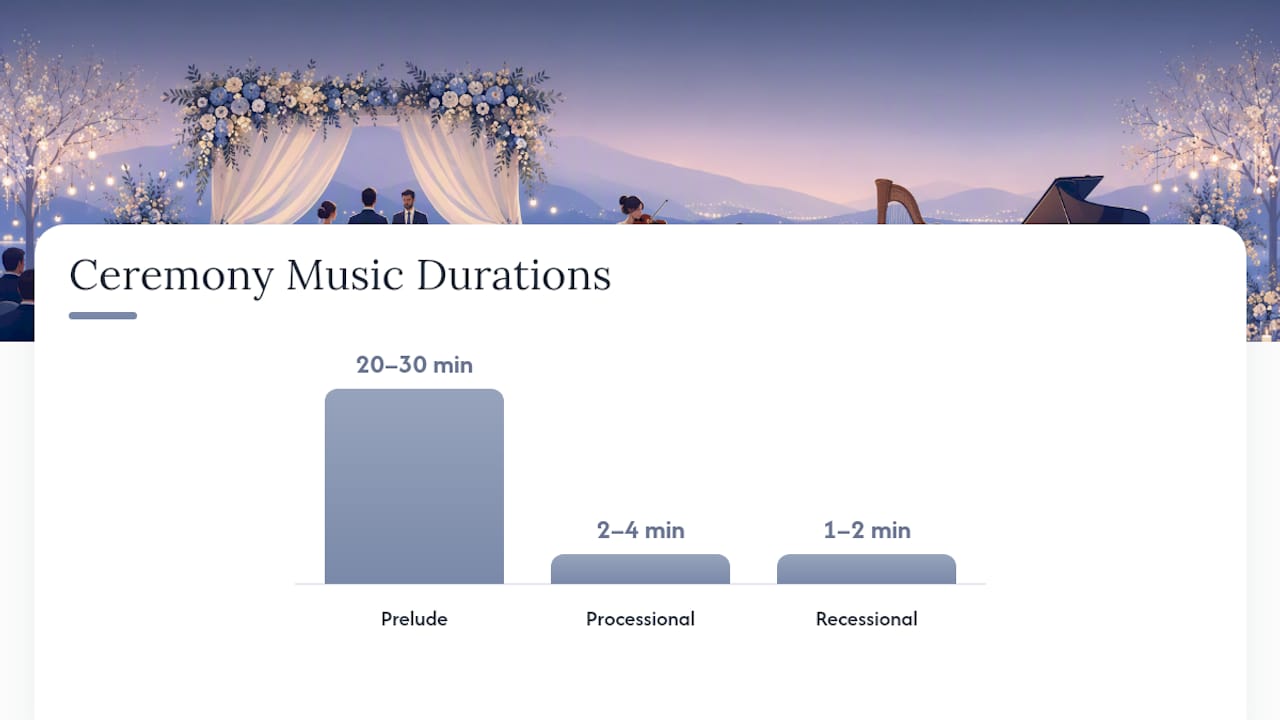
- Prelude (20 to 30 minutes before start): ambient, low-key pieces while guests arrive and are seated
- Processional (2 to 4 minutes total): a distinct, recognizable piece for the wedding party, often shifting tone for the bride's entrance
- Recessional (1 to 2 minutes): upbeat, celebratory music as the couple exits
Repertoire splits between canonical pieces (Pachelbel's Canon, Wagner's Bridal Chorus) and bespoke arrangements of a couple's favorite song reworked for strings or piano. Bespoke arrangements have become far more common over the past several years, since they personalize a moment that used to sound identical at every wedding.
Pro Tip: Ask your ensemble whether they can arrange a non-classical song for your instrumentation before you fall in love with the idea. Not every pop song translates cleanly to solo violin, and a good arranger will tell you honestly if it won't work.
Cocktail Hour: Atmosphere, Volume, and Set Length
Cocktail hour has one job: get guests talking to each other before the formal reception starts. That's a completely different acoustic problem than the ceremony or the dance floor.
A trio or soloist creates intimacy that a full band can't. When Alexander Vineyards hosts wine-and-music pairing events, they lean on small chamber formations precisely because a quieter, more textured sound lets conversation stay at the center of the room instead of competing with it. Psychology writers covering chamber music at wine tastings note the same pattern: intimate ensembles support close listening and discussion rather than drowning it out.
A few practical guidelines carry over to any upscale gathering, wine tasting event music included:
- Keep volume at conversational level, roughly the sound of a busy restaurant, not a concert
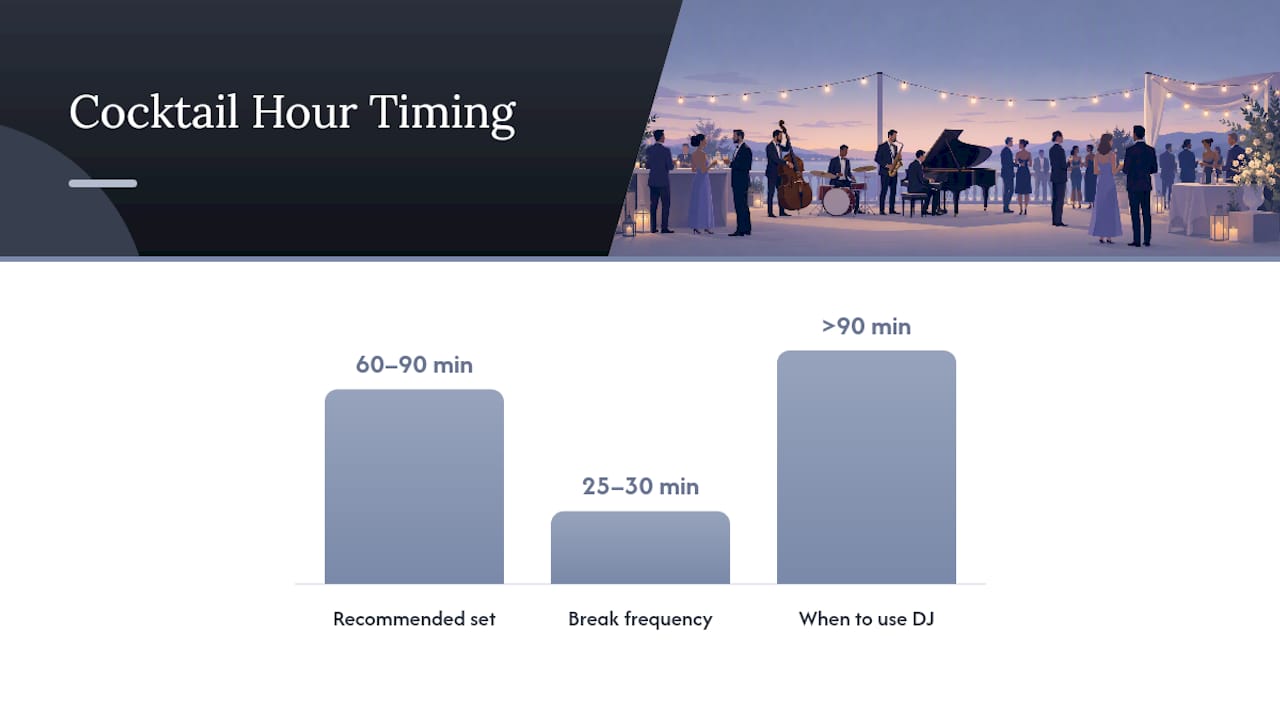
- Plan for a 60 to 90 minute set with short breaks every 25 to 30 minutes to avoid musician fatigue
- Use a hybrid DJ and live setup if cocktail hour needs to stretch past 90 minutes, so recorded tracks cover breaks without losing continuity
- Save higher-energy material for the very end of cocktail hour, as a bridge into the reception
Reception Music and the Move to Dancing
The reception has an arc, and boutique providers plan for it in phases rather than treating the whole evening as one long playlist. Dinner calls for lower-key, largely instrumental music that supports table conversation. Toasts need near silence with cues ready to resume. Then energy has to climb, deliberately, toward the first dance and open floor.
Programming that arc matters more than any single song choice. Research on retail and event sound design shows the same phased approach at work in brand activations: energetic material to open, ambient textures through the middle, then a clear ramp into higher tempo for the crowd's peak moment.
For the reception specifically, keep these in mind:
- Dinner music: mid tempo, mostly instrumental, low enough to talk over comfortably
- First dance: many couples use live instrumentation for a personal arrangement, then blend in the recorded original if the arrangement doesn't capture it exactly
- Open floor: this is where a hybrid DJ and live band setup earns its cost, since a DJ can sustain danceable energy for hours in a way a four-piece band playing live sets can't without breaks
- Confirm PA and staging early. A gap of even 90 seconds between the toast ending and music resuming is when a room's energy visibly drops
Matching Ensembles and Formats to Your Event's Mood
Guest count and venue type should drive your ensemble choice more than personal taste alone.
- Solo piano or guitar: best for intimate gatherings under 60 guests, or as ceremony/cocktail backup where subtlety matters more than volume
- Jazz trio: a strong fit for cocktail hours and smaller corporate mixers where you want warmth without dominating the room
- String quartet: the standard for formal ceremonies and upscale receptions where visual elegance matters as much as sound, especially for photos
- Swing band or full jazz quartet: suited to receptions of 100+ guests that want a big-band feel without a full DJ setup
- DJ and hybrid live setups: the right call whenever an event needs both live texture early on and sustained dance energy late, without hiring two separate acts
Acoustic and visual fit both matter here. A harpist photographs beautifully at a garden ceremony but gets lost in a 300-person ballroom without amplification. Match instrumentation to venue size before you match it to genre.
Planning and Booking: Timeline, Budget, and Logistics
Boutique musicians book out early, especially for peak wedding months. Waiting until three months out limits your options to whoever happens to be free.
- Lock your date 9 to 12 months ahead for weddings, 3 to 6 months for corporate events, since corporate calendars move faster but venues fill just as quickly.
- Review the contract for four essentials: deposit amount, cancellation policy, a performance rider listing equipment needs, and proof of liability insurance, which most upscale venues now require.
- Confirm logistics directly with the venue: power access near the performance area, a shaded or covered spot for outdoor events, load-in time, and where musicians can take breaks out of guest sightlines.
- Ask specific interview questions: Have they played this exact venue before? What's their backup plan if a musician is sick? Can they send video from a similar event, not just a highlight reel?
Pro Tip: Request an itemized timeline from your musicians, not just a set list. A good boutique provider will hand you a minute-by-minute breakdown of prelude, processional, cocktail hour, and reception cues before you ever sign a contract.
What to Look for in Samples and Reviews
Video and audio samples tell you more than any bio page. Listen for clean tone at low volume, since many samples are recorded loud and hide how an ensemble sounds during quiet dinner conversation.
- Check whether video samples show a real event, not just a studio session with perfect acoustics
- Read testimonials for specifics: mentions of a particular venue, a last-minute request handled well, or a specific song request rather than generic praise
- Confirm insurance and gear ownership directly. A provider who owns their PA system and carries liability coverage tends to run a tighter, more predictable event
- Ask if they've performed at your venue or one with similar acoustics before
Detailed service pages that walk through how live music elevates guest experience are usually a good sign the provider treats planning as seriously as performance.
A Practitioner's Notes on Reading the Room
The best set changes mid-event, not just between songs. I've seen a cocktail hour built around slow jazz standards shift entirely because a crowd of guests kept gathering near the piano and talking louder than intended, and the smarter move was to lean into that energy rather than fight it with volume.
Organizers get better results signaling desired energy in ranges, not exact songs: "keep it warm through dinner, then build." One tip: hand your musicians three reference songs, not thirty. It tells them your taste without boxing them into a set list that can't flex when the room does.
— Alex
Booking Boutique Event Music With Alex Levin Music
Boutique event music services can provide one relationship covering your ceremony, cocktail hour, reception, and DJ transition to keep the dance floor moving, instead of coordinating multiple contracts.
Each service is built around the moments this guide just walked through. Wedding Ceremony Music, Cocktail Hour Music, and Reception Music each start from $3,000, with DJ & Hybrid Music also starting from $3,000 for events that need both live instrumentation and sustained dance energy. If your event calls for a broader look at curated live-music experiences beyond weddings, ensembles like those featured on concert programs pairing orchestral music with signature moments show how far curated programming can go.
Request video samples and check available dates directly through Alexlevinmusic's booking page before your preferred weekend gets taken by someone else.
Sources
- The sound of retail: how music shapes customer experience
- The unspoken values of great chamber music
- Live Jazz for Atlanta Store Openings: Drawing Crowds and Boosting Brand Image
FAQ
What Are Good Songs to Use at Events?
It depends entirely on the phase: prelude and cocktail hours favor mellow instrumental pieces, while receptions need a build toward upbeat, danceable material for the open floor. A boutique provider will typically ask for three to five reference songs from you, then build appropriate arrangements around that taste rather than relying on a fixed list.
What Is the Best Background Music for an Event?
Background music works best when it's calibrated to conversation volume and matched to the room's energy in phases, not played at one constant level all night. Small ensembles or soloists, jazz trios and string duos among them, tend to outperform full bands for this purpose since they can shift dynamically without overwhelming the space.
What Kind of Music Do You Play at a Corporate Event?
Corporate events usually favor jazz, swing, or acoustic arrangements that feel polished without pulling focus from networking or speeches. Practitioners have found that live jazz functions as a crowd magnet at brand activations, and the same phased approach, energetic open, ambient middle, upbeat close, applies directly to corporate programming.
What Music Attracts Customers or Guests?
Live music with a clear energy arc consistently outperforms a static playlist for drawing and holding a crowd, since it can respond to real-time changes in foot traffic or guest mood. This is why retail activations and store openings so often lean on live music as a strategic tool rather than defaulting to recorded sound.
How Much Does Boutique Event Music Cost?
Pricing varies by service and ensemble size, but Alexlevinmusic's ceremony, cocktail hour, reception, and DJ & hybrid packages each start from $3,000. Exact pricing for corporate entertainment and specific ensemble types like a jazz quartet or string quartet is available directly on the Alexlevinmusic site.