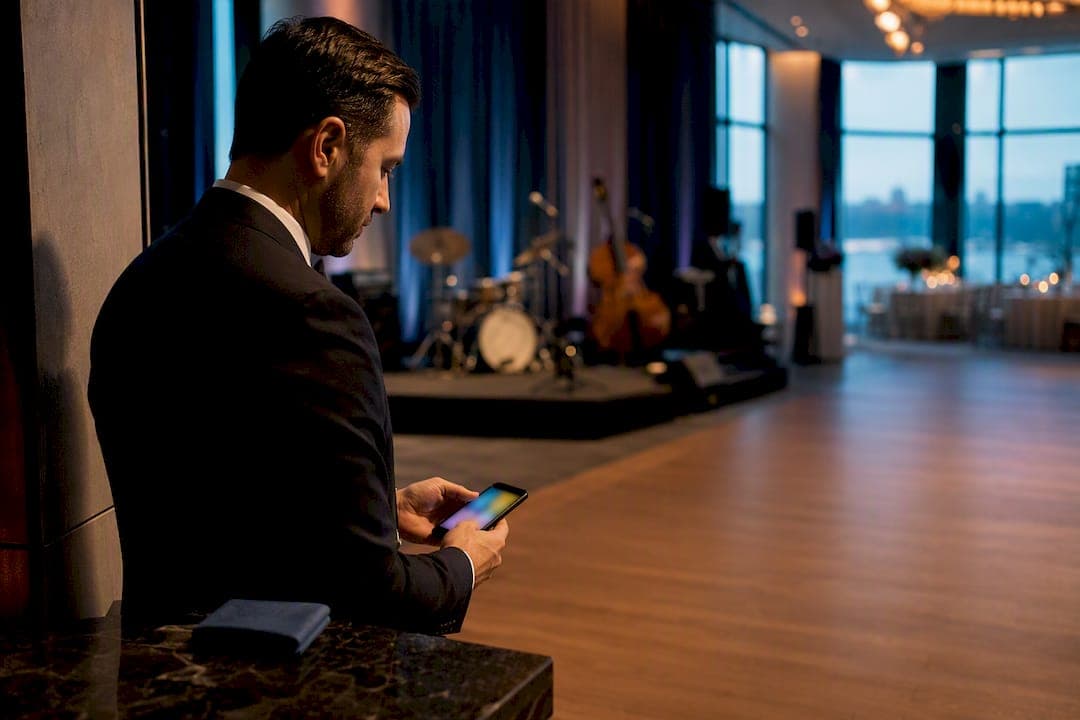
The fastest way to avoid dead air during band breaks is to name one person responsible for break music and put it in writing before the wedding. Your three real options are a DJ who stays on through the breaks, a smaller combo pulled from the band itself, or a prepped playlist run by a specific, named operator. Which one fits depends on your budget and how much you care about a fully live sound from cocktail hour to last dance.
TL;DR:
- Having a designated operator for break music and clarifying their role in the contract prevents dead air and ensures smooth transitions.
- Plugins like a DJ, a small live combo, or a pre-made playlist are reliable options, with hybrid setups offering the most seamless coverage if budget permits.
- Proper planning includes a detailed run sheet with exact times, operator contacts, cue lines, and testing of the sound system to avoid technical failures.
- Match break music tempo and style to the live set using instrumental or light arrangements, and prepare multiple songs to cover typical break durations.
- Confirm venue licensing and clarify who supplies and manages break playback in advance, with actual testing before the event day.
Table of Contents
- Where Band Breaks Fall in a Wedding Reception Timeline
- Which Option Actually Covers Break Music Best?
- Building the Run Sheet and Assigning Who Presses Play
- Playlist Ideas That Don't Break the Mood
- Contract Details and Licensing You Need to Confirm
- How Alex Levin Music Handles Break Continuity
- The Part Most Couples Get Wrong About Break Music
- A Simpler Way to Handle the Whole Reception
- Sources
- FAQ
Where Band Breaks Fall in a Wedding Reception Timeline
Most live bands play in blocks, not straight through, and the pattern usually looks like one of three setups: two 60-minute sets with one longer break, multiple sets with shorter breaks, or multiple sets with regular breaks scattered through the night. The right pattern depends on how long your reception runs and how much dancing you want packed into it.
Timing matters more than the exact count of sets. A long break should sit somewhere the room is already sitting down and talking, like dinner, speeches, or cake cutting, since nobody expects to dance during those moments anyway. Short breaks work best wedged between two high-energy sets, right after a big dance run when guests are ready to grab a drink.
- Long breaks (20+ minutes): dinner service, formal toasts, cake cutting
- Short breaks (10 to 15 minutes): between dance sets, during a natural lull
- Flex breaks: let the bandleader shift timing if the dance floor is still packed, rather than cutting off momentum on a fixed clock
Good bands read the room. Ask your bandleader directly whether they'll delay a scheduled break if the floor is still full. Most will, but it needs to be discussed before the day, not negotiated in real time over a microphone.
Which Option Actually Covers Break Music Best?
Four approaches work, and each has a different cost and reliability profile. Here's how they stack up.
- DJ stays on the whole night. A DJ who works alongside the band handles transitions smoothly and can read the crowd the same way the band does. Confirm the fee upfront and ask exactly how the handoff between DJ and band will sound, since a jarring genre switch mid song is the most common complaint.
- The band supplies a smaller combo during its own breaks. Some bands offer a duo or trio pulled from the full lineup to keep a live sound going while the rest of the group rests. It typically costs more, but it means guests never hear a recording at all, and the tone stays consistent with the main set.
- A prepped playlist run through the venue's system. This is the cheapest option by far, but it only works if someone specific owns the laptop or phone, and the equipment has been tested on-site beforehand.
- A hybrid setup, where a DJ handles every break and the band handles every set. This tends to be the strongest all-around choice when the budget allows it, because you get seamless coverage without asking the band to do double duty.
Reception size and venue AV support usually decide the call. A 300-guest ballroom with a full production team can lean on a hybrid setup without much extra planning. A backyard reception for 60 people might do just fine with a well-built playlist and one attentive friend running it.
Pro Tip: Ask your venue coordinator, not just your band, whether the venue's sound system can output from a phone or laptop directly. Some older systems only accept a wired mic feed, which kills a playlist plan on the spot.
Building the Run Sheet and Assigning Who Presses Play
A run sheet is the single document that prevents most break-music failures, and it needs four things for every transition: the exact time window, who initiates the cue, the precise wording the MC or bandleader will use, and a backup contact if that person is unreachable. This structure removes guesswork in the moment, which is exactly when things tend to go wrong.
Practitioners who plan receptions for a living say the most commonly missed detail isn't the music itself. It's that nobody was ever assigned to press play, so when a break starts, three people assume someone else has it handled and the room goes quiet.
A complete run sheet should include:
- Exact start and end time for every set and break
- Named operator for each transition, plus a backup
- The MC's exact cue line for handing off to break music
- Load-in and sound-check windows confirmed with the venue
- Direct phone numbers for the bandleader, DJ, and venue AV contact
Test the entire playback chain, venue speaker system through DJ device through actual files, at the sound check, not the morning of. Codec issues, dead Bluetooth connections, and expired streaming logins are the most common causes of dead air, and they're avoidable with a five-minute test run.
Playlist Ideas That Don't Break the Mood
Break music should sound like a continuation of the live set, not a jarring reset. A useful rule of thumb: keep the tempo within about 10 to 15 BPM of what the band was just playing, and lean on instrumental or lightly arranged versions of familiar songs if dinner is still happening around the room.
Different moments call for different playlists:
- Dinner and background: soft jazz instrumentals, acoustic covers, and low-key standards that don't compete with conversation
- Transition builders: mid-tempo tracks that slowly rebuild energy heading into the next live set
- Short dance bursts: familiar, high-energy songs that keep a few guests moving if the break runs during an active window
Prepare several songs to cover a typical break period, roughly one song every two minutes, and mark two or three as "must-play" in case the break runs short, with the rest as flexible filler. Instrumental covers work particularly well here because they carry the emotional tone of a familiar song without pulling focus away from dinner conversation.
Contract Details and Licensing You Need to Confirm
Before signing with any band or DJ, get these items in writing, not verbally promised:
- Exact set times and break lengths
- Whether continuous music is included or billed as an add-on, and the overtime rate if the night runs long
- Who supplies and operates break music, by name
- The contingency plan if a band member gets sick or equipment fails
Every one of these belongs in the contract and run sheet before you sign anything, not worked out over text messages the week of the wedding.
On the licensing side, performance rights organizations like ASCAP require venues or event organizers to hold coverage for publicly performed music, and recorded playback can trigger different fee structures than live performance. Some organizers sidestep this by using a licensed B2B catalogue for ambient background playback, but that kind of service does not cover a live band's setlist or an outside playlist you built yourself. Ask your venue directly whether they hold blanket licensing, and get the answer in writing.
How Alex Levin Music Handles Break Continuity
A typical run-of-show for a reception might look like this: cocktail hour runs 45 minutes with a trio pulled from the full band, dinner runs 40 minutes with a recorded jazz playlist operated by the bandleader's assistant, and every dance set runs 45 minutes with 15-minute breaks covered by the same trio setup used at cocktail hour.
Contracts typically include set times, break lengths, and who operates any recorded playback to avoid last-minute decisions on-site.
- Backup operators are usually designated for transitions
- Sound-check windows are typically scheduled before guests arrive
- Performance video samples and reference clips may be available on request prior to booking
Pro Tip: Ask any prospective vendor to walk you through their actual run sheet from a past event, not just describe their process. A real document tells you far more than a sales pitch.
The Part Most Couples Get Wrong About Break Music
Most wedding advice treats band breaks like a minor logistics footnote, something to mention once and move on. That's backwards. Dead air during a reception is one of the most noticeable failures a wedding can have, because it happens in front of every single guest at once, and there's no graceful way to hide it.
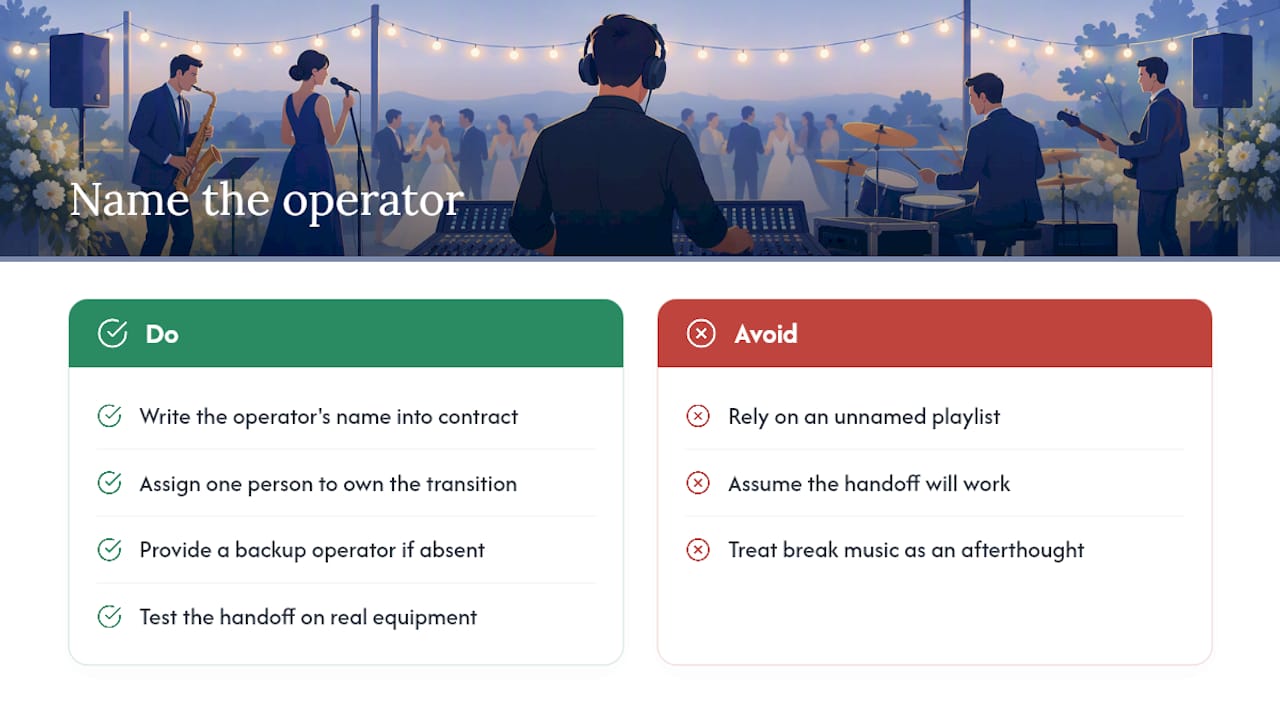
The conventional advice tells couples to "have a backup playlist ready." That's not wrong, but it's incomplete to the point of being useless. A playlist without a named operator is just a file sitting on someone's phone. The actual fix isn't musical, it's operational: one person owns the transition, a backup exists if that person disappears, and the handoff gets tested on the real equipment before the wedding day, not assumed to work.
If you take one thing from this article, make it this: write the operator's name into the contract, not just the songs. Bands and DJs who already build this into their process, rather than treating it as an afterthought, are worth paying a little more for.
— Alex
A Simpler Way to Handle the Whole Reception
There's a reason so many couples end up juggling a band contract, a separate DJ quote, and a homemade playlist just to avoid a few minutes of silence. It's a lot of coordination for something that should be simple. Alex Levin Music handles ceremony, cocktail hour, reception, and DJ and hybrid coverage under one booking, so the run sheet, the break coverage, and the transitions are built by the same team instead of stitched together between vendors who've never met.
When you reach out, ask to see a sample run sheet, request video clips from a past reception, and ask specifically how break coverage works for your guest count and venue. If continuous play matters to you, say so in the first email. You can start that conversation on the services page or go straight to the contact page to check dates.
Sources
- The Ultimate Guide: Wedding Playlist (Junebug Weddings)
- ASCAP special event license information (ASCAP)
- Event music license in the US: ASCAP, BMI, and SESAC basics for one-off events (Sonosfera)
- Best instrumental wedding songs (The Knot)
FAQ
What Songs Work Best for a Band to Play at a Wedding?
Bands generally build sets around a mix of familiar crowd favorites, a few first-dance or parent-dance ballads, and high-energy closers that fill the dance floor. The exact list should shift with your guest demographics, so share a few must-play and do-not-play songs with your bandleader ahead of time.
What Is the Most Commonly Played Wedding Song?
There's no single universally agreed-upon "number one" wedding song, since trends shift by region, generation, and reception style. Ask your band or DJ for their current most-requested list, since it changes year to year and venue to venue.
What Is the Best Exit Song for a Wedding?
The best exit song is whatever high-energy, widely recognizable track matches the couple's taste and gets guests clapping as the newlyweds leave the room. Many couples pick something upbeat and personal rather than a generic "wedding" song, since this is one moment guests will remember clearly.
What Do You Call the Music Played as a Couple Exits a Wedding?
It's typically called the "exit song" or "send-off song," and it's usually the last track played before guests line up for the couple's departure. Some receptions also use a shorter instrumental version during the actual walk-out, distinct from the full send-off track played beforehand.
Do I Need to Worry About Licensing for Recorded Playback During Breaks?
Yes, if you're playing recorded music at your reception, the venue or vendor generally needs coverage through a performance rights organization like ASCAP. Ask your venue directly whether they hold blanket licensing, and get written confirmation before the wedding.