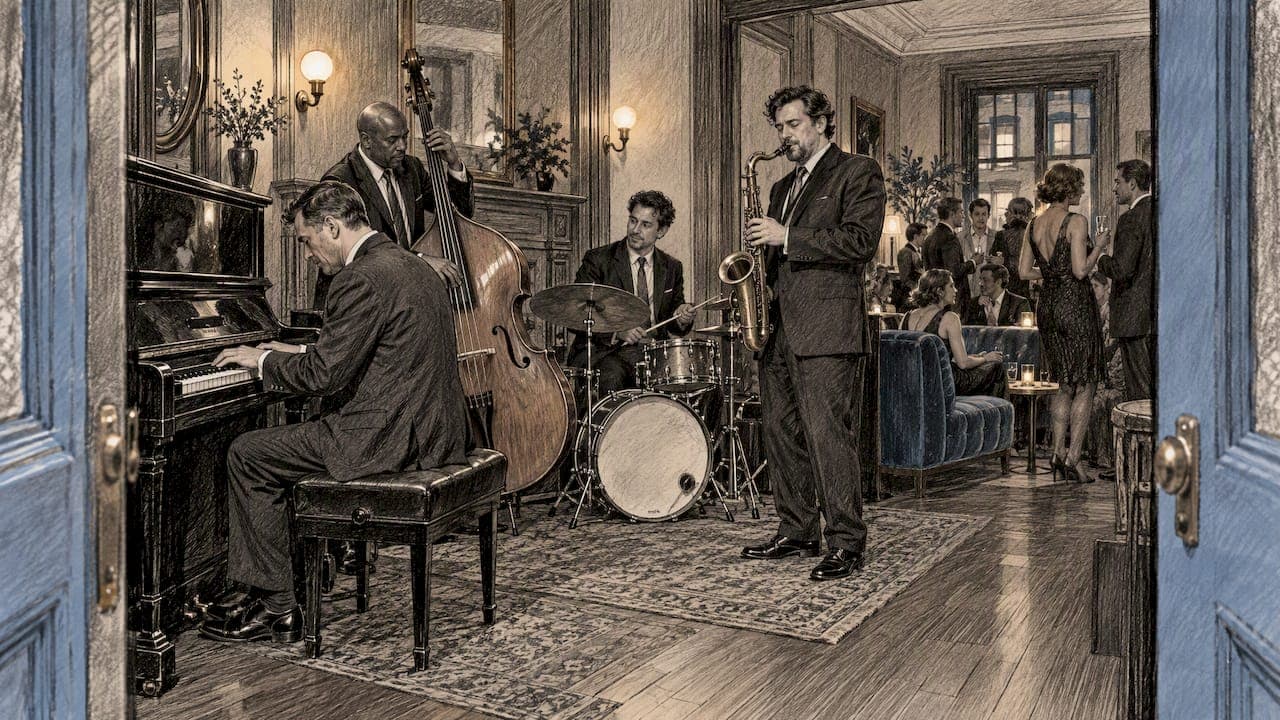
The best speakeasy party music is live, small-scale and a little bit hidden: a piano trio or small jazz combo playing 1920s and 1930s standards at conversation volume early on, then swinging harder once the room warms up. A playlist can set the theme. A band makes guests believe it. Below you will find the era to draw from, a song list, the ensemble options, a timeline for the night, and the licensing question most hosts never think about.
TL;DR
- Build the night around Prohibition-era jazz and swing: Louis Armstrong, Duke Ellington, Fats Waller, then Big Band numbers once people want to dance.
- Live music beats a playlist for atmosphere. A jazz trio, quartet, solo pianist or swing band each suit a different room size and budget.
- Start low and intimate, then build energy. Volume, not just song choice, is what makes a space feel like a speakeasy.
- In the US, the venue usually carries the public performance license. Confirm it in writing before you sign.
- Our Reception, Cocktail Hour, Ceremony and DJ & Hybrid music start at $3,000 per event.
Table of Contents
- What speakeasy music actually was
- A song list that sets the scene
- Live band, DJ or both
- Shape the night: a simple timeline
- Speakeasy wedding music
- Other kinds of speakeasy parties
- Perspective: why we steer hosts away from "all-1920s"
- Licensing: who pays for the music
- What to ask before you book
- Book speakeasy music with us
- FAQ
- Sources
What speakeasy music actually was
The theme works because the history is real. Prohibition ran from 1920 to 1933, and the Mob Museum's history of the era explains that the federal ban on liquor pushed jazz forward by creating a nationwide underground nightclub culture. Clubs competed for crowds, and music was how they won them.
That same source names Louis Armstrong, Duke Ellington and Fats Waller as defining voices of the period. It also notes that Bessie Smith sold one million records by 1920 and that more than 550 licensed radio stations were operating nationwide by 1922. Music was becoming the shared language of the decade.
There is a social angle worth borrowing too. According to the museum's page on the speakeasies of the 1920s, these rooms were among the first places where men and women drank and socialized together openly. That is why the sound is not just moody. It is danceable, flirtatious and a bit rebellious. Your party should feel like that, not like a museum.
Authentic versus speakeasy-inspired
Strictly period music means hot jazz, early swing, blues and Tin Pan Alley songs from roughly 1920 to 1933. Most hosts want something broader: the speakeasy look with the full range of jazz and swing up to the 1940s, and sometimes a few modern songs rearranged in that style. Both are valid. Decide which you are doing before you book, because it changes the musicians you need.

A song list that sets the scene
Here is a starting point. These are standards, so a working jazz group will know most of them or can learn them quickly.
| Moment | Songs and styles | Why it works |
|---|---|---|
| Arrival, first drinks | "Ain't Misbehavin'" (Fats Waller), "Mood Indigo" (Duke Ellington), "Summertime" | Familiar, warm, easy to talk over |
| Dinner or conversation | Ballads and mid-tempo swing, instrumental piano trio arrangements | Keeps the room intimate |
| Building energy | "In the Mood," "Sing, Sing, Sing," "Route 66" | Recognizable to nearly every age group |
| Dance floor | Uptempo swing, Charleston numbers, Big Band favorites | Gets people moving together |
| Late night | Slow jazz, torch songs, a final singalong | Lets the night land softly |
The Mob Museum page lists "Sing, Sing, Sing," "In the Mood" and "Ain't Misbehavin'" among the hits that remain essential for speakeasy-themed events, and the first of those is a showpiece for a swing band. "Route 66" is a later song, recorded by the King Cole Trio in 1946 according to Swing & Beyond, so it is not strictly Prohibition-era. It is still a fine piano-trio crowd-pleaser if you are going for speakeasy-inspired rather than historically exact.
Why the Google playlists are not enough
Search for this topic and you will mostly find streaming playlists and ambience videos. They are handy for a pre-party hour or a bar tab at home. They are not a plan for a hosted event: nobody adjusts the volume to the room, nobody calls the first dance, and nobody notices when the crowd is ready for something faster. That is the gap a live musician fills.
Live band, DJ or both
The biggest decision is the format. Here is how the common options compare for a speakeasy-themed event.
| Format | Best for | Watch out for |
|---|---|---|
| Solo piano | Small gatherings, cocktail hours, lounges with limited space | Less dance energy |
| Jazz piano trio | Dinner parties, cocktail hours, 40 to 150 guests | Needs room for a piano or keyboard setup |
| Jazz quartet | Receptions and corporate evenings that want more presence | Larger footprint |
| Swing band | Dancing, big rooms, a true Jazz Age feel | Volume has to be managed in small spaces |
| String quartet | Ceremonies and elegant arrivals, with jazz-era arrangements | Less suited to late-night dancing |
| DJ and live hybrid | Long events that need live atmosphere early and nonstop dancing later | Needs a clear plan for handoffs |
All of these are formats we play. For parties that run several hours, the hybrid is often the most practical. The live group carries the first half, when the speakeasy mood matters most, and a DJ takes over for late dancing with swing, electro swing and period-flavored remixes. If you want to see how that works, our DJ & Hybrid Music page lays out the approach, and our post on why to hire a DJ for your event covers when a DJ earns their place.
Personality matters as much as skill
Lounge and jazz writers keep returning to one point. In the Los Angeles Times obituary of a longtime lounge singer, the legacy of acts like Louis Prima and Keely Smith rests on live interaction, banter and reading the audience. Take that into your hiring. When you watch video samples, look beyond the playing. Do the musicians look at the room? Do they change tempo when people drift? A great speakeasy band does.
Shape the night: a simple timeline
The speakeasy feeling comes from contrast. Dim, quiet and secretive at the start; loud and joyful by the end. Here is a pacing plan you can adapt.
- Doors and first drinks (45 to 60 minutes). Solo piano or trio at low volume. Guests should still hear each other clearly. Let the music feel like it is coming from the next room.
- Dinner or main mingling. Keep to ballads and relaxed swing. Avoid anything that makes people raise their voices.
- The turn. Announce a toast, a first dance or a reveal, then shift to uptempo numbers. This is the moment the band should be able to improvise around.
- Dancing. Swing, Charleston-style tunes and a couple of recognizable crowd songs. Give nondancers a place to sit that is still near the music.
- Last call. One or two slow songs. End on purpose, not by running out of playlist.
If you are hosting at home or in a smaller private space, our guide to cocktail jazz for private gatherings goes deeper on volume, placement and set length. For events that move from dinner into dancing, seamless music planning for private events covers the transitions.
Speakeasy wedding music
Couples who want a speakeasy wedding rarely want the whole day in costume. The usual approach is to give each part of the day its own sound:
- Ceremony: keep it elegant. A string quartet or solo pianist can play jazz-era melodies without turning the ceremony into a theme party. See our wedding ceremony music options.
- Cocktail hour: this is where the speakeasy idea shines. A piano trio in a dim, candlelit lounge area is the most natural fit. Our cocktail hour music is built for this, and we wrote about setting the mood with live music instead of background noise.
- Reception: a swing band or a live and DJ hybrid keeps the energy up. Our reception music page shows the formats.
The key is to keep the speakeasy theme in the music and lighting, not to force it on every guest. Older relatives will enjoy swing standards they know. Younger guests tend to respond to a jazz band that plays one or two modern songs in an older style.
Speakeasy or Gatsby?
The two themes overlap but feel different. Speakeasy is smaller, darker and secretive: bourbon, low light, a trio in the corner. Gatsby is larger and glitzier: champagne, a full dance floor and a bigger ensemble. If you are leaning toward the second, our post on great Gatsby party music and hiring the right live jazz band will help you choose.
Other kinds of speakeasy parties
Not every speakeasy event is a wedding. We hear most often from three kinds of hosts.
Corporate events. A speakeasy-style reception works well for client dinners, holiday parties and launches because jazz is polished without being stuffy. Our advice on selecting the perfect jazz ensemble for corporate events and on striking the right tone between formal and fun applies directly.
Holiday parties. Swing and jazz suit winter gatherings naturally. See swinging into the holidays with live jazz.
Milestone birthdays. A 30th, 40th or 50th often combines activity and atmosphere. If your group wants to start with games, some entertainment venues run adult birthday event packages with activities first. You can then move the evening to a separate lounge-style space where the speakeasy music takes over.
Perspective: why we steer hosts away from "all-1920s"
We play jazz, swing and sophisticated styles for weddings, corporate gatherings and private celebrations, and the most common mistake we see in speakeasy planning is rigidity. Hosts hand over a list of 1920s songs and ask the band to stick to it all night. Within an hour, half the room is on their phones.

Our approach is different. We treat the theme as a mood, not a rulebook. We open with the period standards that make the room feel transported, then let the set follow the guests. If a table of friends starts singing along to a Sinatra tune, we lean in. If the dance floor wants something faster, we pick up the tempo. The musicianship matters, but so does the ability to read a room and make the night feel effortless.
So when you brief us, tell us the story you want guests to remember, and a few songs you love and a few you cannot stand. We will build the arc around that.
— Alex
Licensing: who pays for the music
This is the part nobody puts on a mood board. In the US, public performance of copyrighted songs needs a license. LegalClarity explains that the obligation usually belongs to the venue rather than to the band, and that venues typically hold blanket licenses from performing rights organizations such as ASCAP, BMI, SESAC and GMR.
For private, non-ticketed events, Art and Media Law puts typical costs at $100 to $500 per event, though enforcement varies. It also reports that ASCAP's 2026 rate schedule for nightclubs starts at a $502 minimum, with surcharges based on occupancy. Those are general figures, not a quote for your event.
What to do about it:
- Ask your venue, in writing, whether it holds blanket licenses for live music.
- If you are using a private space such as a loft, warehouse or backyard, ask the venue manager or the performing rights organizations what applies. If the event is ticketed or open to the public, expect more scrutiny.
- For legal certainty on your own situation, talk to the venue's counsel or an entertainment attorney. We cannot give legal advice.
What to ask before you book
- Can I see video of the exact lineup? A trio video does not tell you how a quartet sounds.
- How will you adjust volume? Ask how the group handles dinner versus dancing.
- What are the space and power needs? Pianos, amps and staging affect where the band can go.
- How much can the repertoire be customized? Good groups take requests and can arrange a surprise song.
- What does the price include? Confirm the lineup, performance length, setup and any travel fees.
Our guide on how to choose the right musician for your event style and audience goes through the same checklist in more detail.
Book speakeasy music with us
We perform live jazz, swing and elegant ensembles for weddings, corporate events and private celebrations in Philadelphia, New York and beyond. Our wedding ceremony music, cocktail hour music, reception music and DJ & hybrid music each start at $3,000 per event. Jazz trios, quartets, string quartets, swing bands and solo piano are also available, and we customize the lineup and set list to your theme. To tell us about your date and the mood you want, start at alexlevinmusic.com.
FAQ
What music was played at speakeasies?
Mostly jazz, blues, early swing and popular dance tunes of the 1920s and early 1930s. The Mob Museum credits Prohibition-era club culture with advancing jazz, and names Louis Armstrong, Duke Ellington and Fats Waller among its defining musicians. Many of those songs are still staples for themed events.
Should I hire a live band or use a playlist for a speakeasy party?
A playlist is fine for a small gathering at home. For a wedding, corporate event or large party, live musicians create the atmosphere and adjust to the crowd in real time. A hybrid is a good choice if you want live jazz early and a DJ for late dancing.
How much does live speakeasy music cost?
Our ceremony, cocktail hour, reception and DJ & hybrid music packages start at $3,000 per event. The final price depends on the lineup, event length and location, so request a quote for your date. Separate from the musicians, ask your venue about its music licensing.
Do I need a music license for a private speakeasy party?
In most cases the venue is responsible for holding the right public performance licenses, not the band. Private, non-ticketed events often cost less, but rules and enforcement vary. Ask your venue to confirm in writing, and see an entertainment attorney if your situation is unusual.
Sources
- The Rise of Jazz and Jukeboxes, Prohibition: An Interactive History (The Mob Museum)
- The Speakeasies of the 1920s, Prohibition: An Interactive History (The Mob Museum)
- "(Get Your Kicks on) Route 66" (1946), The (Nat) King Cole Trio, Swing & Beyond
- Los Angeles Times: Marty and Elayne Roberts, lounge singer obituary
- Do Cover Bands Pay Royalties? The Venue Usually Does, LegalClarity
- Live Event Music Licensing: Legal Guide for Venues & Organizers, Art and Media Law