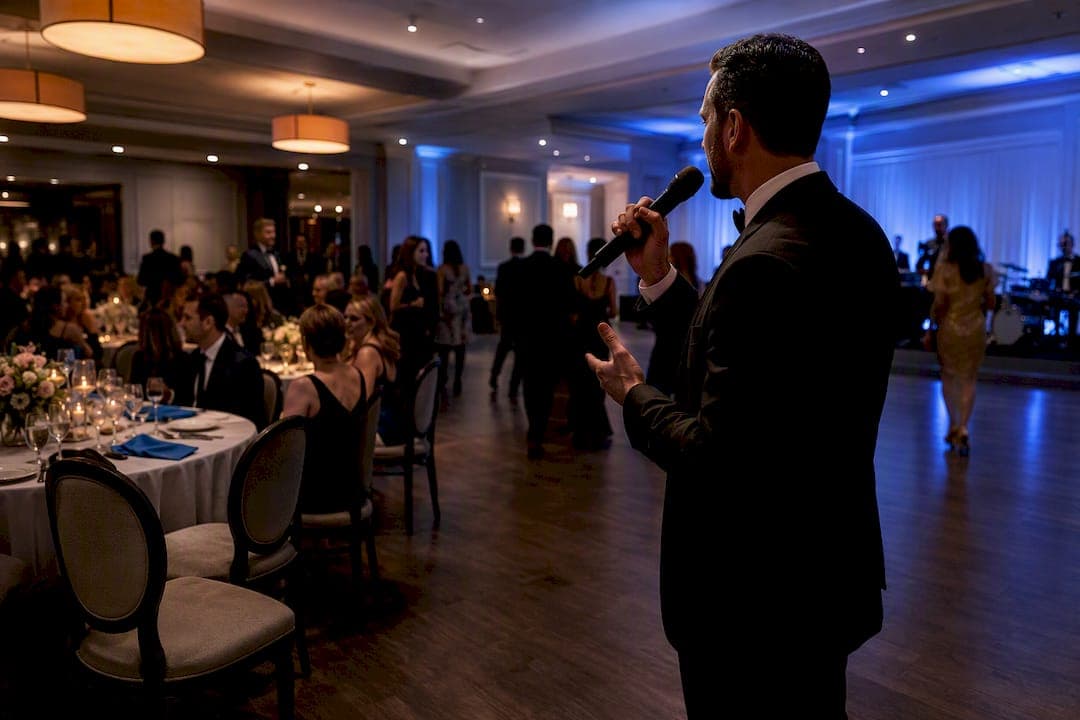
Dinner music sits under conversation and builds slowly toward the dance floor. Dancing sets do the opposite: they demand attention and get people moving. The single rule that governs both is momentum, not mood. Schedule one or two mellow dinner sets, end them with a clear musical cue, and open dancing with a song everyone already knows. Alex Levin Music builds these transitions for a living, and the pattern holds whether the band is a jazz trio or a full DJ setup.
TL;DR:
- Guests need a clear musical cue or announcement to signal the transition from dinner to dancing, ideally during the last dinner song or a tempo ramp.
- Proper sequencing involves building about thirty minutes of momentum before a smooth shift into high-energy dance music, avoiding abrupt changes.
- Dinner music typically remains soft and relaxed with instrumental or acoustic covers, while dance sets feature familiar, groove-driven tracks at over 100 BPM.
- Regional and cultural traditions influence the timing of dinner and dance segments, with some cultures blending or reversing the Western pattern.
- Confirming sound levels and transition plans with vendors ensures a seamless flow, preventing awkward pauses or unintentional energy drops.
Table of Contents
- Dinner Music vs Dancing Sets: What Actually Separates Them
- Sequencing and Timing: The 30/5 Transition Rule
- Building the Playlist: Dinner Sets and Dance Openers
- Volume, Arrangement, and Live vs. DJ Choices
- Questions to Ask Your Musician or DJ Before Booking
- What Real Bookings Teach About Dinner-to-Dance Transitions
- Where Dinner Music and Dancing Sets Actually Came From
- Why Music Choice Changes How Guests Feel and Behave
- How Regional and Cultural Traditions Shape the Split
- The Editorial Take: Stop Treating the Transition as an Afterthought
- How Alex Levin Music Handles Your Dinner-to-Dance Transition
- Sources
Dinner Music vs Dancing Sets: What Actually Separates Them
Dinner sets exist to disappear into the background. Their job is texture, not attention. A good dinner set lets a table of eight carry on a conversation without raising their voices, which means the arrangement has to stay soft, unhurried, and mostly instrumental. Dancing sets flip that entirely. They're built to grab focus, drive tempo, and give people something familiar enough to sing along to within the first four bars.
The tempo gap is the clearest signal of the divide. Dinner sets typically run in a relaxed moderate tempo range, or use tracks with no fixed beat at all, like ambient jazz ballads. Dance sets climb past 100 BPM and stay groove driven, prioritizing a steady kick and a hook over subtlety.
Instrumentation tells the same story:
- Dinner: acoustic jazz trio, string quartet, solo piano, or soft synth lounge textures
- Dancing: full band with rhythm section, DJ remixes, or added percussion for drive
Version choice matters more than most planners realize. Instrumental or acoustic covers work at dinner because they carry melody without pulling focus toward lyrics. Radio edits and remixes work for dancing because guests already know the words and the beat. Curated dinner collections, including Epidemic Sound's dining-out catalog, lean on jazz, soft house, and lofi for exactly this reason: familiar warmth without demanding attention.
Sequencing and Timing: The 30/5 Transition Rule
Most receptions follow a recognizable shape: cocktail hour, one or two dinner sets, a first dance, then a run of dance-party sets until last call. The details inside that shape are where planners either nail the flow or lose it.
- Cocktail hour (45 to 60 minutes): upbeat but conversational, slightly livelier than dinner.
- Dinner sets (20 to 40 minutes each, one or two total): quiet, textured, built for talk.
- First dance and family dances (10 to 15 minutes): a clear tonal shift, often live.
- Dance sets (30 to 60 minutes each): full energy, minimal breaks.
Wedding-planning guides that map reception phases against playlists consistently structure the night this way, and for good reason. It maps to how guests move through an evening, from settling in to letting loose.
The "30/5" idea is a working guideline, not a strict formula: build roughly a half-hour of rising momentum, then use a short transition window, an announcement, a lighting change, or a tempo ramp inside the last song, to signal the shift before dancing opens. Bands with fixed set lengths sometimes need to compress that window to a couple of minutes; DJs with continuous mixing can stretch it.
Pro Tip: Ask your MC or bandleader to announce the first dance by name before the song starts. That brief cue does more to fill a dance floor than any song choice.
Building the Playlist: Dinner Sets and Dance Openers
Dinner playlists work best when they stay in a consistent mood rather than jumping between genres. Think traditional jazz standards, soft bossa nova, acoustic guitar instrumentals, mellow R&B, lounge piano, and quiet indie covers. Curated "dinner chill" playlists on platforms like Spotify tend to rotate these same categories because low-energy, melodic tracks keep a room comfortable without going silent.
Dance openers need the opposite: an immediate, recognizable hook and a beat guests can lock onto within seconds. Classic singalongs, mainstream pop hits, and rhythmic R&B with a strong groove all work. The strongest openers share one trait: almost nobody in the room needs the first ten seconds to recognize the song.
A sample dinner set (several songs):
- Jazz standard, instrumental version
- Bossa nova guitar piece
- Soft piano ballad
- Acoustic cover of a well-known love song
- Mellow R&B instrumental
- Lounge-style jazz vocal, low register
- Quiet indie acoustic track
- String quartet arrangement of a classic tune
A sample dance opener (several songs):
- One unmistakable, high-recognition anthem
- A classic singalong from a different decade
- A rhythmic pop or R&B track with a strong four-on-the-floor beat
- A crowd-favorite from the couple's generation
- A tempo bridge track that ramps energy further
Choosing the right edit matters as much as the song itself. Instrumental takes and lower-key vocal versions suit dinner because they sit quietly in a mix. Tempo-matched segues, where one song's outro blends into the next song's intro at a similar BPM, keep dance sets from losing energy between tracks.
Volume, Arrangement, and Live vs. DJ Choices
Volume is the most underrated variable in reception planning. Dinner music should sit at a level where guests can talk in a normal voice across a six-foot table. Dance sets need enough sound pressure to feel physical without distorting or triggering a complaint from the venue. Documenting both levels with your sound tech in advance, rather than guessing in the moment, avoids the most common complaint planners hear afterward.
Live ensembles and DJs each bring different strengths to this problem:
- Live ensembles offer tonal warmth, real-time dynamic control, and the ability to read a room and adjust on the fly.
- DJs offer precise beat-matching, instant tempo changes, and a massive song catalog with no rehearsal needed.
- Hybrid setups, a soloist playing over a DJ's dinner track or a live band bridging directly into a DJ-led dance set, combine both, and these combinations are increasingly common requests among clients who want intimacy without sacrificing dance-floor reliability.
Pro Tip: If you're using a hybrid setup, insist on a shared playlist document between your live musicians and your DJ. A five-minute handover conversation prevents an awkward key or tempo clash at the transition.
Confirm sound check windows, available stage space, monitor needs, and a backup plan for equipment failure before signing anything.
Questions to Ask Your Musician or DJ Before Booking
A vendor who can't answer these clearly is a vendor worth pushing back on.
- Can you share sample dinner and dance set lists from past events?
- How flexible is your run-time if dinner service runs long?
- What's your process for cueing the transition from dinner to dancing?
- Who handles announcements, you, an MC, or the venue coordinator?
- What are your set and break lengths, and what's your overtime rate?
- What equipment do you provide, and what falls on the venue's sound tech?
Get set lengths, break lengths, overtime rates, and equipment responsibilities written into the contract, not just discussed on a call. A vendor who refuses to share sample recordings, hedges on timing, or won't discuss transitions is a red flag worth taking seriously. Build these answers into your day-of timeline and repeat them in your final vendor confirmation email so nothing gets lost between booking and the event itself.
What Real Bookings Teach About Dinner-to-Dance Transitions
One recent reception called for a jazz trio through dinner, then a tempo ramp into upbeat swing before handing off to a DJ for the dance set. Guests barely noticed the switch; they just noticed the energy climbing. Another event used a solo pianist for a quiet, intimate dinner, then brought in a full band for dancing, with the bandleader announcing the first dance live to bridge the gap.
Readers can see more of this approach on the dinner-to-dancing planning guide and the dinner music explainer. Three habits show up in almost every smooth transition:
- Swap arrangements gradually rather than cutting hard from acoustic to electric.
- Ramp tempo within the last dinner song instead of jumping straight to a fast track.
- Coordinate the MC's announcement with the exact moment the music shifts.
Where Dinner Music and Dancing Sets Actually Came From
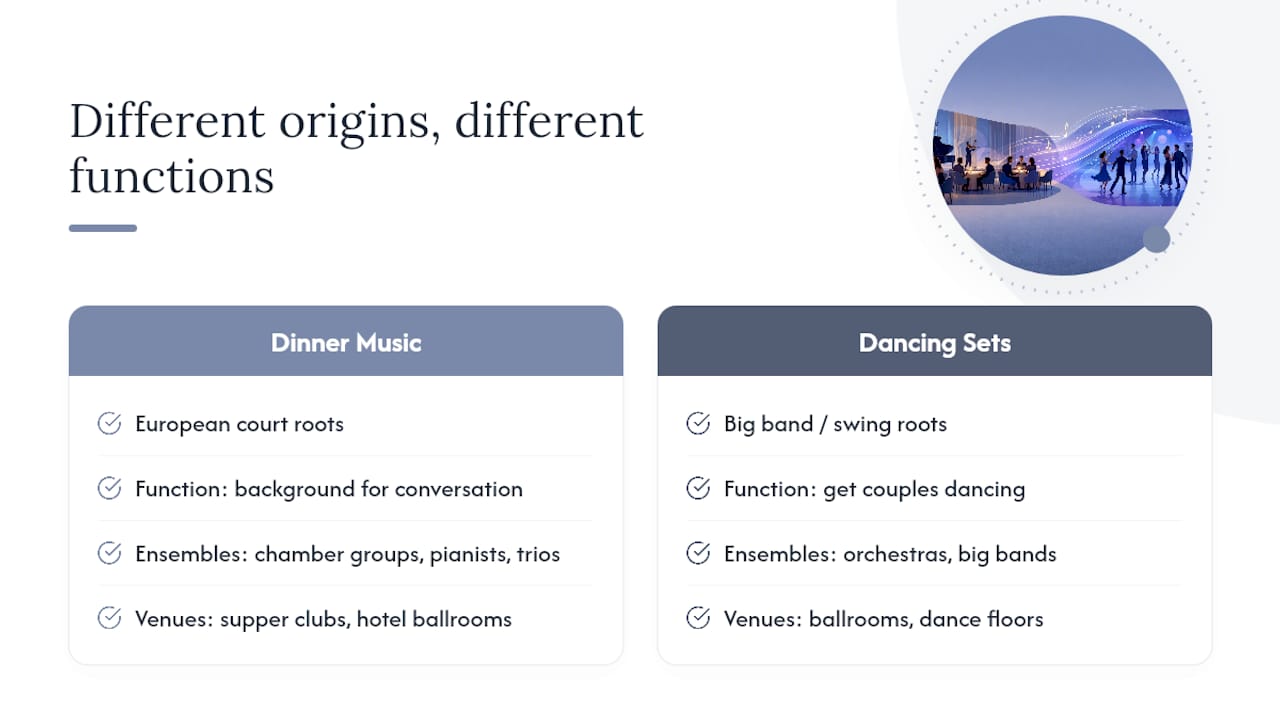
Dinner music has roots in European court traditions, where chamber ensembles played quietly during formal meals so conversation among nobility could continue undisturbed. That function, sound as social lubricant rather than entertainment, carried into American supper clubs and hotel ballrooms in the early 20th century, where a house trio or pianist worked dinner service before a bigger band took over for dancing.
Dancing sets trace back to the same ballroom era, but their DNA comes from a different place: the big band and swing circuit of the 1930s and 1940s, where orchestras built entire shows around getting couples onto the floor. The distinction between "eating music" and "dancing music" wasn't accidental. Venues staffed different ensembles, or asked the same band to shift arrangements, because they understood a listening room and a moving room require different sound.
Modern wedding receptions inherited this split almost intact. What changed is who provides it. A single string quartet or jazz trio might now cover dinner while a DJ handles the dance set, a combination that would have been unusual in a 1950s ballroom but reflects the same underlying logic: match the sound to the activity. The historical throughline matters because it explains why the two feel so different even when played by the same musicians. They were never meant to do the same job.
Why Music Choice Changes How Guests Feel and Behave
Music during dinner works on a different psychological register than music during dancing, and the difference isn't subtle once you notice it. Slow tempo and low volume during a meal reduce cognitive load, which is a technical way of saying guests can actually hear each other and relax into conversation. Fast, loud, or lyrically dense music competes for the same mental bandwidth people need to talk, which is why starting dinner too intense disrupts the room rather than energizing it.
Dance music flips that mechanism intentionally. A strong beat at a higher tempo triggers a physical response, the urge to move, and familiar songs add a social one: recognition creates a shared moment across a room full of people who may not know each other. That's why a well-chosen opener can pull people out of their seats faster than an announcement ever could.
There's a sequencing lesson buried in this. A DJ or bandleader who jumps straight from ambient dinner jazz to a full-energy dance anthem is asking guests to shift psychological states instantly, and that abrupt switch often confuses more than it excites. A tempo ramp or a short vocal cue gives guests time to mentally reset from "conversation mode" to "dance floor mode." It's a small production choice with an outsized effect on how full the floor looks fifteen minutes later.
How Regional and Cultural Traditions Shape the Split
Dinner and dance conventions shift noticeably across cultural backgrounds, and a planner working with a multicultural guest list needs to account for that early. Italian and Greek receptions, for instance, often blur the line entirely, live music plays continuously from dinner through dancing, with folk and traditional tunes doubling as both background texture and dance triggers once energy builds. South Asian weddings frequently reverse the American pattern: high-energy dance sets, including Bollywood and Bhangra numbers, appear earlier in the evening and coexist with dining rather than following it.
Jewish weddings often build toward a specific ritual dance moment, the hora, that functions as a hard transition point much like a first dance does in Western receptions, complete with its own musical cue that guests recognize instantly. Latin American celebrations frequently keep a live band through both segments, shifting from bolero or salsa-adjacent dinner music into full-tempo salsa, bachata, or cumbia for dancing, with almost no DJ handoff at all.
None of this means one tradition is more "correct" for sequencing. It means the planner's job is to ask early, and specifically, what a couple's cultural background expects rather than defaulting to a single Western template. A vendor experienced with varied traditions will ask about this during the first planning call, not the week of the event.
The Editorial Take: Stop Treating the Transition as an Afterthought
Most reception planning advice spends 90 percent of its energy on song selection and almost none on the handoff between dinner and dancing. That's backwards. The songs matter, but the transition is where receptions actually fall apart, guests left standing awkwardly near an empty dance floor because nobody gave a clear signal that it was time to move.
The conventional wisdom treats dinner music and dance music as two separate playlists to build. They're really one continuous arc, and the weakest link is almost always the middle: the three to five minutes where energy needs to climb, an announcement needs to land, and the first song needs to be unmistakable. Get that part right and the rest mostly takes care of itself.
If you take one thing from this: stop asking your vendor "what songs do you play?" and start asking "how do you handle the moment dinner ends?" That question separates vendors who've thought seriously about flow from ones who haven't.
— Alex
How Alex Levin Music Handles Your Dinner-to-Dance Transition
Alex Levin Music is built specifically around this handoff, not just around playing good music in isolation. Whether the plan calls for a jazz trio through dinner, a solo pianist for cocktail hour, or a hybrid setup that bridges live instrumentation into a DJ-led dance set, the arrangements, tempo ramps, and MC coordination get planned before the event, not improvised in the moment.

Every booking includes access to sample sets and ensemble options so you can hear exactly how a dinner set sounds next to a dance opener before you commit. If you want a closer look at how the transition itself gets built, the dinner-to-dancing planning guide walks through real examples. When you're ready to talk specifics, whether that's ensemble size, repertoire, or how a hybrid DJ handoff would work for your venue, check available dates and services to start the conversation.
Sources
- Background Dinner Music - Dining out | Epidemic Sound
- Wedding Music Guide | DJ vs Band & What to Play When
- Why Dinner Music Matters More Than Couples Think