
Most couples spend months choosing their wedding music and minutes reading the contract. That gap is where problems happen. A vague or missing clause in your wedding music contract essentials can mean a band shows up an hour late, charges you double for overtime, or plays nothing like what you discussed. The contract is not paperwork formality. It is the document that turns your vision into a legally binding commitment. This guide walks you through every section that matters, so you sign with confidence and spend your wedding day dancing instead of arguing.
Table of Contents
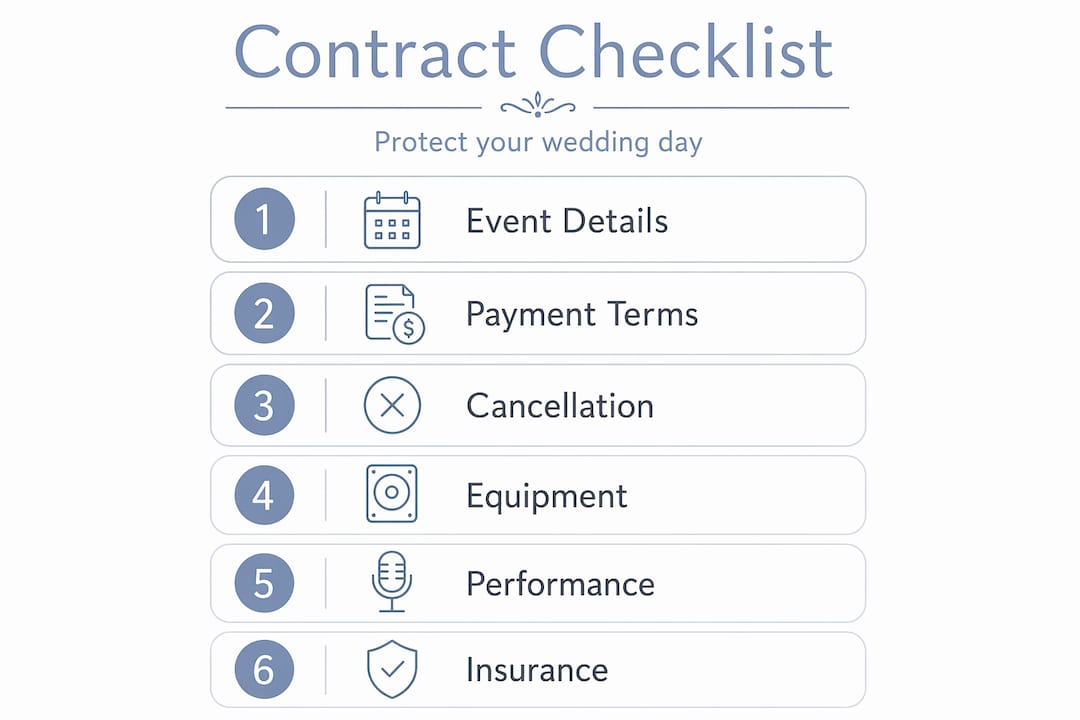
- Understanding the basics: date, time, venue, and setup logistics
- Pricing, deposits, and payment schedules: securing your budget
- Cancellation policies and what happens if plans change
- Equipment and technical setup: who provides what and when
- Performance terms: song requests, discretion, and special moments
- Liability, insurance, and overtime: protecting your investment
- Why a clear, detailed music contract is your best wedding day insurance
- Ensure your wedding music is flawless with our professional services
- Frequently asked questions
Key Takeaways
| Point | Details |
|---|---|
| Event details accuracy | Your contract should clearly state the exact wedding date, venue, and setup times to avoid confusion. |
| Clear payment terms | Specify total price, deposit, payment schedule, and methods to prevent surprise charges. |
| Cancellation clarity | Understand refund rules based on when you or the vendor cancel to manage financial risks. |
| Equipment responsibilities | Clarify who provides what gear and setup logistics to avoid day-of misunderstandings. |
| Overtime and insurance | Define overtime rates and ensure vendor carries liability insurance for protection. |
Understanding the basics: date, time, venue, and setup logistics
The most common day-of music disasters trace back to one root cause: nobody wrote it down. A well-structured wedding music contract spells out the event date, venue address, arrival time, setup window, performance start, and performance end as separate line items. Not as a single vague block of text.
Why does separating arrival from performance start matter? Because a band or DJ needs time to load in, set up, and soundcheck before guests arrive. If your contract only says "performance begins at 6:00 PM" and the venue requires load-in through a service entrance that takes 45 minutes, you have a conflict nobody planned for.
Here is what your contract's logistics section should explicitly include:
- Exact event date (day, month, year, no abbreviations)
- Full venue name and street address, including suite or floor if applicable
- Vendor arrival time for load-in, separate from guest arrival
- Setup and soundcheck window with a hard deadline
- Performance start time and expected end time
- Breakdown and load-out window after the performance ends
- Parking or load-in instructions if the venue has specific requirements
Pro Tip: Before you sign, review the questions to ask before booking your wedding band to make sure the logistics conversation happens before the contract is drafted, not after.
| Logistics detail | Why it matters |
|---|---|
| Arrival time vs. performance start | Prevents rushed setups and late starts |
| Setup window | Ensures soundcheck is complete before guests arrive |
| Breakdown window | Avoids overtime charges from venue or performer |
| Venue address and access | Eliminates load-in confusion on the day |
Knowing why the basics matter, next we'll cover how to handle the money matters clearly to avoid surprises.
Pricing, deposits, and payment schedules: securing your budget
Money disputes are the number one reason wedding vendor relationships go sideways. A detailed payment schedule with total price, deposit amount, installment due dates, and accepted payment methods eliminates the gray area where those disputes live.
Here is the payment information your contract must contain:
- Total cost of services, broken down by what is included (performance hours, equipment, travel)
- Deposit amount and whether it is refundable or non-refundable
- Deposit due date, typically at signing
- Remaining balance due date, often 2 to 4 weeks before the event
- Accepted payment methods (check, bank transfer, credit card)
- Late payment penalties, including whether late payment triggers cancellation
A few things couples often overlook:
- Travel fees for venues outside a standard radius
- Meal or accommodation requirements for multi-hour or destination events
- Sales tax, if applicable in your state
Pro Tip: When you find your wedding band or DJ, ask for a full fee breakdown in writing before the contract is drafted. Any verbal quote that does not appear in the contract does not exist legally.
Never assume a verbal agreement about pricing holds up. If a vendor promises to waive a travel fee during your initial call but the contract lists it, the contract wins.
Cancellation policies and what happens if plans change
Nobody plans to cancel their wedding entertainment. But life happens, venues flood, and vendors get sick. Your contract needs to handle both scenarios: you canceling, and them canceling.
A solid cancellation policy typically looks like this:
- More than 90 days out: Deposit forfeited, no further obligation
- 30 to 90 days out: Deposit forfeited plus a percentage of remaining balance
- Fewer than 30 days out: Full contract price owed, regardless of cancellation reason
- Vendor cancels: Full refund issued, plus potential reimbursement for replacement costs
"If the performer cancels for reasons other than documented emergencies, the contract should require a full refund plus reimbursement for costs incurred finding a replacement." This clause protects you from being left without music two weeks before your wedding.
The backup performer clause is one of the most overlooked items on any wedding entertainment contract checklist. Ask directly: if the contracted performer cannot appear, who replaces them? Is the substitute of comparable skill and style? Does the contract require your approval of the substitute?
Avoiding common wedding music planning mistakes starts here. Couples who skip this clause often find themselves scrambling for last-minute entertainment at inflated prices.
Equipment and technical setup: who provides what and when
This section of your live music contract details prevents the most awkward conversation possible: standing in your reception hall two hours before guests arrive, asking who was supposed to bring the PA system.
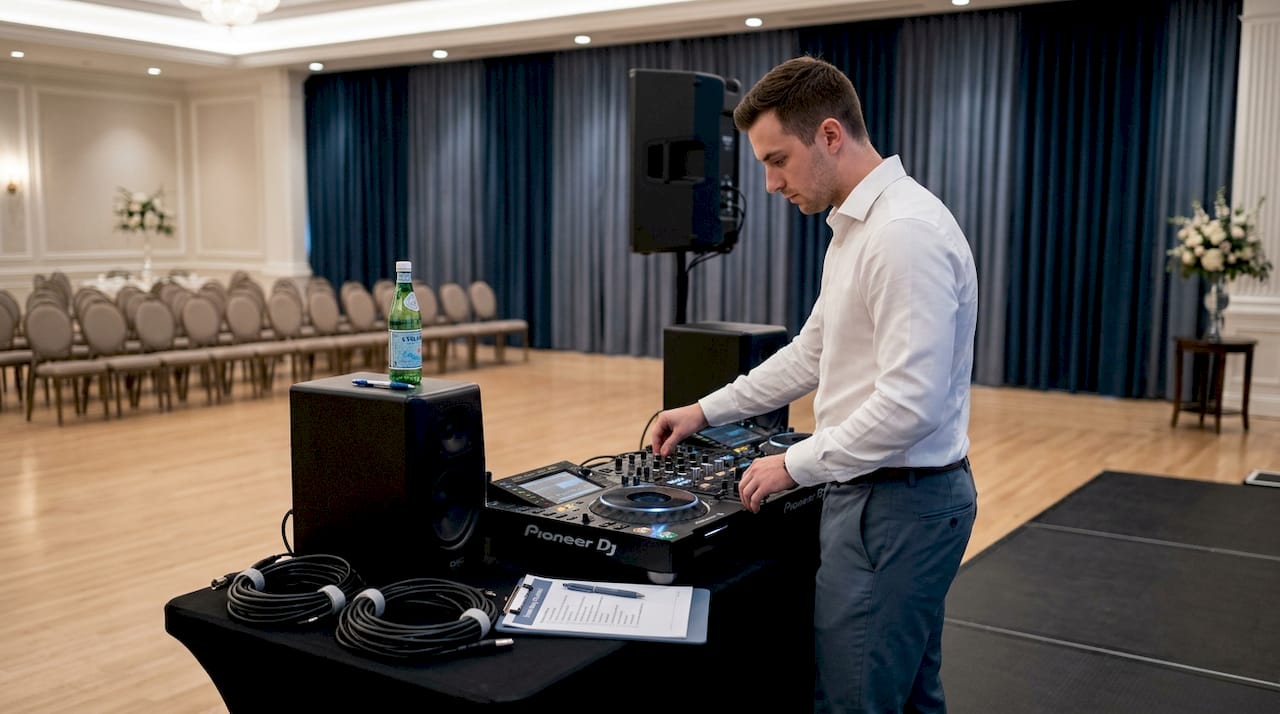
A clear equipment clause specifies exactly what the performer brings, what the venue provides, and what falls on you as the client.
Key items to address:
- Sound system and speakers (who provides, what size/capacity)
- Microphones for toasts, ceremony officiants, or announcements
- Lighting equipment, if included in the package
- Power requirements and whether the venue meets them
- Table or staging space for equipment setup
- Backup equipment policy in case of technical failure
Pro Tip: For private event music planning, always confirm equipment specs with the venue coordinator before finalizing the contract. Some historic venues have power limitations that affect what a band or DJ can safely run.
| Equipment item | Typically provided by DJ | Typically provided by live band |
|---|---|---|
| PA system and speakers | DJ | Shared or venue |
| Mixing board | DJ | Band |
| Microphones | DJ | Band |
| Stage lighting | DJ (sometimes) | Rarely included |
| Instrument amplifiers | Not applicable | Band |
| Backup equipment | DJ responsibility | Band responsibility |
Performance terms: song requests, discretion, and special moments
Here is something most couples do not realize until it is too late: a standard wedding musician agreement gives the performer significant discretion over song selection. Requests are welcome, but they are not guaranteed unless the contract says otherwise.
Must-play and do-not-play songs should appear as explicit deliverables in the contract, not as a casual email you send three weeks before the wedding. If your first dance song, the father-daughter dance, and the processional music are not listed in the contract, they are preferences, not obligations.
Your performance terms section should cover:
- Must-play list with song titles and artists, tied to specific moments (ceremony, first dance, cake cutting)
- Do-not-play list, especially important if you have strong genre preferences or family sensitivities
- Request policy during the reception: are guests allowed to request songs, and does the performer have final say?
- Genre or style restrictions, if you want to maintain a specific atmosphere
- Medley vs. full song expectations for key moments
Pro Tip: If you are hiring a DJ for your event, ask them to confirm in writing that they have access to every song on your must-play list before you sign. Licensing limitations occasionally prevent certain tracks from being played.
Verbal conversations about music feel productive in the moment. Written contract terms are what actually get honored on the day.
Liability, insurance, and overtime: protecting your investment
Two clauses that couples routinely skip over are the ones that protect them most when something goes wrong. Liability insurance and overtime terms are not fine print. They are financial protection.
Reputable performers carry liability insurance, and many venues require proof of at least $1 million in coverage before allowing a vendor on-site. Your contract should require the performer to provide a certificate of insurance naming the venue as an additional insured if the venue requests it.
What your liability and insurance clause should address:
- Proof of liability insurance with specified minimum coverage amount
- Who is responsible for damage to venue property caused by the performer's equipment
- Injury liability if a guest or vendor is injured due to the performer's setup
For overtime, clear billing terms prevent the most common post-wedding financial surprise.
- Overtime rate stated as a multiplier (typically 1.5x to 2x the hourly rate)
- Minimum billing increment (usually 30 minutes or one hour)
- Approval process: who authorizes overtime, and how (verbal on the night, written request)
- Payment method for overtime: collected at the event or invoiced after
"Overtime rates and minimum increments should be locked into the contract before the event, not negotiated at 10:30 PM when everyone is having a great time and nobody wants the music to stop."
Avoiding last-minute music planning mistakes means reading every line of this section carefully, not just the total price.
Why a clear, detailed music contract is your best wedding day insurance
After years of performing at weddings across Philadelphia, New York, and beyond, here is what we know for certain: the couples who have the best wedding day experiences are not necessarily the ones with the biggest budgets. They are the ones who did the work upfront.
A written contract signals a professional relationship that both parties take seriously. It is not a sign of distrust. It is a sign of respect for everyone's time, money, and expectations.
The uncomfortable truth about wedding music contracts is that most disputes are not about bad intentions. They are about different assumptions. You assumed the DJ would play the full version of your first dance song. The DJ assumed a radio edit was fine. Neither of you was wrong, exactly. But one of you had it in writing and one of you did not.
The questions to ask before booking your wedding band are only valuable if the answers end up in the contract. A conversation is a memory. A contract is a commitment.
We would also push back on the idea that a longer contract is more intimidating. In our experience, a thorough contract is actually more reassuring to couples, not less. It shows the performer has thought through every scenario and is prepared to handle it professionally. Vague one-page agreements should raise more concern than detailed five-page ones.
Ensure your wedding music is flawless with our professional services
You have done the work of understanding what belongs in a strong wedding music contract. Now comes the part where you find a performer who already has all of it covered.

At Alex Levin Music, every booking comes with a clear, detailed agreement that covers all the essentials: event logistics, payment schedules, cancellation terms, equipment responsibilities, and performance specifics. You can explore our live wedding bands and musicians, browse our full range of soloists and ensembles for weddings, or get details on our live band reception music packages. From jazz trios to full bands and DJ services, we serve couples across Philadelphia, New York, and beyond with the kind of professionalism that makes your wedding day feel effortless.
Frequently asked questions
What are the must-have sections in a wedding music contract?
A wedding music contract must include event date and venue details, pricing and payment schedules, cancellation policies, equipment responsibilities, performance terms, and liability insurance clauses to ensure clarity and legal protection.
Is it common for music vendors to require a non-refundable deposit?
Yes, most wedding music vendors require a non-refundable deposit to secure the date and compensate for opportunity costs; the exact refund terms depend on cancellation timing as stated in the contract.
How should overtime be handled in a wedding music contract?
Overtime must be clearly defined with specific rates, billing increments, and an approval process; DJ contract guidance recommends collecting overtime payment at the event to avoid post-event billing disputes.
What happens if the wedding music performer cancels unexpectedly?
A strong contract requires the vendor to issue a full refund and may obligate them to find a qualified replacement; cancellation clauses protect the couple financially and ensure the event is not left without entertainment.
Recommended
- Questions to Ask Before Booking Your Wedding Band — and What Their Answers Should Tell You | Alex Levin Music | Wedding Music New York | Wedding Music Philadelphia
- Common Wedding Music Planning Mistakes and How to Avoid Them | Alex Levin Music | Live Wedding Band New York | Live Wedding Band Philadelphia
- 5 Common Music Planning Mistakes Couples Make — and How to Avoid Them | Alex Levin Music | Live Wedding Music New York | Live Jazz Music New York
- Creating Memorable Moments: The Impact of Personalized Jazz Music at Your Wedding | Alex Levin Music | Live Wedding Music Philadelphia | Live Event Music Philadelphia