
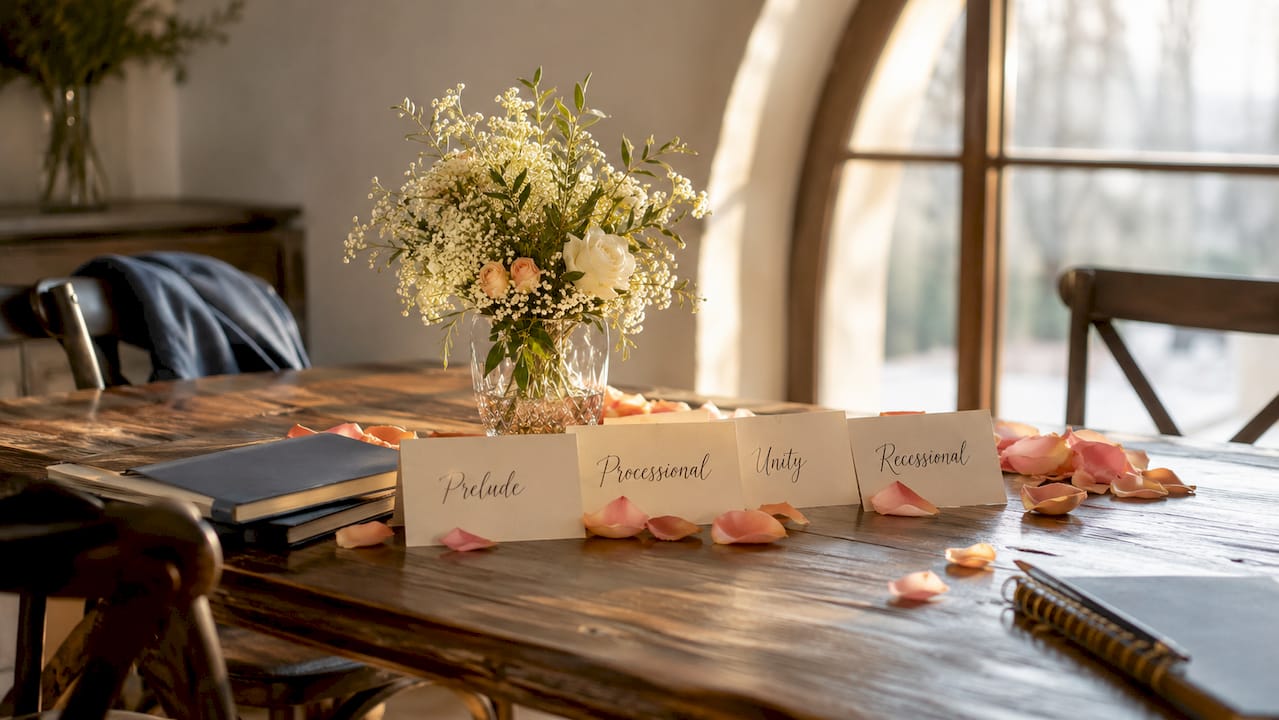
Wedding ceremony music is organized into four distinct functional categories: prelude, processional, unity or interlude, and recessional. Each type serves a specific emotional purpose and shapes how guests experience your ceremony from the moment they arrive to the moment you walk out as a married couple. Getting these categories right is not just about picking songs you love. It is about matching music to ceremony function so that every moment lands with the right emotional weight.
1. Types of wedding ceremony music: the four core categories
Ceremony music has five distinct phases, though most couples plan around four primary types: prelude, processional, unity or interlude, and recessional. Each phase has a defined duration and purpose. Preludes run 15 to 20 minutes with 5 to 7 songs. Processionals cover 3 to 5 minutes. Unity or interlude segments fill 5 to 10 minutes. Recessionals wrap up in 1 to 2 minutes. Understanding this structure before you start picking songs saves you from the most common planning mistake: choosing music you love without knowing where it actually belongs.
The four categories also define the emotional arc of your ceremony. Prelude music creates anticipation. Processional music marks transitions and builds emotion. Unity music holds space for symbolic rituals. Recessional music releases joy. When all four work together, your ceremony feels intentional rather than assembled from a playlist.
2. What prelude music is and how it sets the tone
Prelude music is the background music guests hear while arriving and being seated before the ceremony begins. It typically runs 15 to 30 minutes and covers 5 to 7 pieces. This is the longest uninterrupted music block in your ceremony, and most couples underestimate how much it shapes the room's mood before a single vow is spoken.
Popular styles for preludes include:
- Classical instrumental: Debussy's Clair de Lune, Bach's Air on the G String, Pachelbel's Canon in D
- Acoustic covers: Piano or guitar arrangements of contemporary songs like Ed Sheeran's Thinking Out Loud or Coldplay's The Scientist
- Soft modern melodies: Ambient or neo-classical pieces from artists like Ludovico Einaudi or Max Richter
The processional transition is where most couples lose control of their prelude. Guests notice silence or abrupt changes most in the two minutes before the processional begins. The fix is simple: time your last prelude track to end exactly when the processional cue starts. This requires knowing your song lengths and coordinating with your musician or DJ in advance.
Pro Tip: Keep at least 80% of your prelude instrumental. Lyrics draw attention and pull guests into the song rather than the room. Save vocal tracks for moments that deserve full focus.
3. What processional music is and why it matters for entrances
Processional music cues the entrance of family members, the wedding party, and finally the couple. Most ceremonies use two or three distinct processional pieces: one for parents and grandparents, one for the bridal party, and one for the bride, groom, or both. Each entrance deserves its own musical moment rather than a single continuous track.
Tempo is the most overlooked technical factor in processional selection. Processional pieces typically run 70 to 80 BPM, which matches a natural, dignified walking pace. Songs outside this range either rush the procession or create awkward slow motion. Most ceremonies require 4 to 6 pieces total to cover all musical moments comfortably.
Common processional choices include:
- Traditional: Canon in D (Pachelbel), Jesu, Joy of Man's Desiring (Bach), Ave Maria (Schubert)
- Modern instrumental covers: String quartet arrangements of Beyoncé's Halo, piano versions of A Thousand Years by Christina Perri
- Contemporary originals: Bloom by The Paper Kites, Can't Help Falling in Love by Elvis Presley in a slow arrangement
Pro Tip: Measure the length of your aisle and time a practice walk before finalizing your processional song. A 60-second song may not cover a 90-second walk, and starting the chorus at the wrong moment can undercut the emotional peak you planned for.
4. What unity and interlude music selections are
Unity music plays during symbolic rituals within the ceremony: candle lighting, sand ceremonies, ring warming, or signing the marriage license. This segment typically covers 1 to 3 tracks lasting 3 to 6 minutes total. It is the most intimate musical moment in the ceremony, and it is often the most neglected in planning.
Good unity music choices share three qualities:
- Understated: The music supports the ritual without competing with it
- Appropriate length: Tracks should match the duration of the ritual, not end early or loop awkwardly
- Emotionally resonant: Soft vocals or purely instrumental pieces work best here
Suitable examples include Turning Page by Sleeping at Last, You Are the Best Thing by Ray LaMontagne in an acoustic arrangement, or instrumental pieces like Experience by Ludovico Einaudi. The goal is to hold the emotional space, not fill it with noise. Matching instrumentation to ritual segments produces a more cohesive ceremony than running the same genre throughout every phase.
5. How recessional songs celebrate the joyful exit
The recessional is the music played as the newly married couple and guests exit the ceremony space. It runs 1 to 2 minutes and should be the most upbeat, celebratory piece in your entire ceremony program. This is the emotional release after the weight of vows and rituals, and it sets the tone for everything that follows at the reception.
Mendelssohn's Wedding March remains the most recognized recessional in church settings, and for good reason. Its tempo and triumphant character match the moment precisely. Modern alternatives include:
- Signed, Sealed, Delivered by Stevie Wonder
- Happy by Pharrell Williams
- September by Earth, Wind and Fire
- Here Comes the Sun by The Beatles
- A jazz or swing arrangement of any classic pop song
Live performance adds particular value during the recessional. A live ensemble can read the room, extend the piece if guests are slow to exit, and build energy in real time. A recorded track ends when it ends, regardless of what is happening in the room.
6. How live wedding music options compare to recorded tracks
Live ceremony music creates a presence that recordings cannot replicate. A live musician breathes with the room, adjusts tempo to the procession, and responds to unexpected pauses. A recording plays at exactly the same speed every time, which is both its strength and its limitation.
| Factor | Live music | Recorded music |
|---|---|---|
| Timing flexibility | Adjusts in real time to procession pace | Fixed; cannot adapt to delays |
| Emotional presence | Fills the room acoustically and visually | Consistent but can feel flat |
| Song selection | Limited to ensemble's repertoire | Virtually unlimited |
| Cost | Higher investment | Lower cost |
| Best for | Processionals, recessionals, prelude | Specific recorded versions, tight budgets |
The acoustic effect of live music in a ceremony space is also worth considering. A string quartet or solo piano in a church or ballroom produces natural reverb and warmth that a speaker system rarely matches. For couples planning outdoor ceremonies, live music carries differently than indoors, and wind or ambient noise can affect both live and recorded options.
Pro Tip: If your budget allows only one live element, prioritize the processional and recessional. These are the two moments guests remember most clearly, and live music's timing flexibility matters most exactly when emotions are highest.
Top wedding ceremony music ensembles to consider include string quartets, jazz trios, solo piano, acoustic guitar duos, and harp soloists. Each ensemble produces a distinct tonal character. A live music experience from a jazz trio, for example, brings warmth and sophistication that a string quartet cannot, and vice versa. Match the ensemble to your ceremony's overall aesthetic, not just your favorite songs.
One practical note for couples planning civil ceremonies: religious songs require pre-approval from registrars, and pieces like Ave Maria, Pie Jesu, and Amazing Grace are often restricted. Submit your ceremony music selections early to avoid last-minute rejections.
Key takeaways
Effective wedding ceremony music requires matching each of the four music types, prelude, processional, unity, and recessional, to its specific emotional function rather than selecting songs based on personal taste alone.
| Point | Details |
|---|---|
| Four distinct music types | Prelude, processional, unity, and recessional each serve a different emotional purpose. |
| Tempo drives processionals | Aim for 70 to 80 BPM to match a natural walking pace and avoid rushed or awkward entrances. |
| Prelude transition is critical | Time your last prelude track to end exactly when the processional cue begins to avoid silence. |
| Live music offers timing flexibility | Live ensembles adjust in real time; recorded tracks cannot adapt to delays or emotional shifts. |
| Civil ceremony restrictions apply | Submit music for registrar approval early, especially for any religious or hymn-like selections. |
What I've learned from building ceremony soundtracks
After working with hundreds of couples across Philadelphia and New York, the pattern I see most often is this: couples spend 90% of their music planning time on the reception and treat the ceremony as an afterthought. They pick three songs they love, hand them to the DJ, and assume the rest will work itself out. It rarely does.
The ceremony is the only part of your wedding where every single guest is in the same room, paying full attention, at the same time. That is a rare and powerful thing. The music you choose for those 20 to 40 minutes shapes how people feel during your vows, not just around them.
What I have found actually works is treating the ceremony as a four-act emotional journey. The prelude builds quiet anticipation. The processional delivers the emotional peak. The unity music holds the room in stillness. The recessional breaks the tension with joy. When couples plan with that arc in mind, the music choices become obvious. When they plan by personal taste alone, the ceremony often feels like a playlist rather than a performance.
One thing I tell every couple: do not underestimate the power of a single live musician in the right space. A solo pianist playing Clair de Lune as guests arrive does more for the atmosphere than a perfectly curated Spotify playlist ever will. The visual element, watching someone perform, adds a layer of presence that no speaker system can replicate.
— Alex
Bring your ceremony to life with Alexlevinmusic
Planning the right ceremony music is easier when you have an experienced musician who understands both the structure and the emotion behind each moment.
Alexlevinmusic specializes in live ceremony music for weddings across Philadelphia, New York, and beyond. From solo piano preludes to full jazz trio recessionals, every performance is tailored to your ceremony's pacing, venue, and style. Alex works directly with couples to map music selections to each ceremony phase, so nothing feels rushed, silent, or out of place. If you want a ceremony soundtrack that guests will remember long after the last note fades, reach out to Alexlevinmusic to discuss your vision and available dates.
FAQ
What are the four main types of wedding ceremony music?
The four types are prelude, processional, unity or interlude, and recessional. Each covers a distinct phase of the ceremony and serves a different emotional function.
How long should wedding ceremony music last in total?
A typical ceremony music program runs 30 to 45 minutes total. The prelude alone accounts for 15 to 20 minutes, with processionals, unity music, and the recessional filling the remaining time.
What tempo works best for processional songs?
Processional songs perform best at 70 to 80 BPM, which matches a natural, unhurried walking pace. Songs outside this range can make the procession feel rushed or awkward.
Should I use live music or recorded tracks for my ceremony?
Live music adapts in real time to the pace of your procession and fills the room with acoustic presence that recordings cannot match. Recorded music offers consistency and access to specific versions, making it a practical choice when budget is a constraint.
Do civil ceremonies have restrictions on music choices?
Yes. Civil ceremonies often restrict religious hymns and devotional songs. Pieces like Ave Maria and Amazing Grace require registrar approval and are frequently banned. Submit your selections early to avoid last-minute changes.