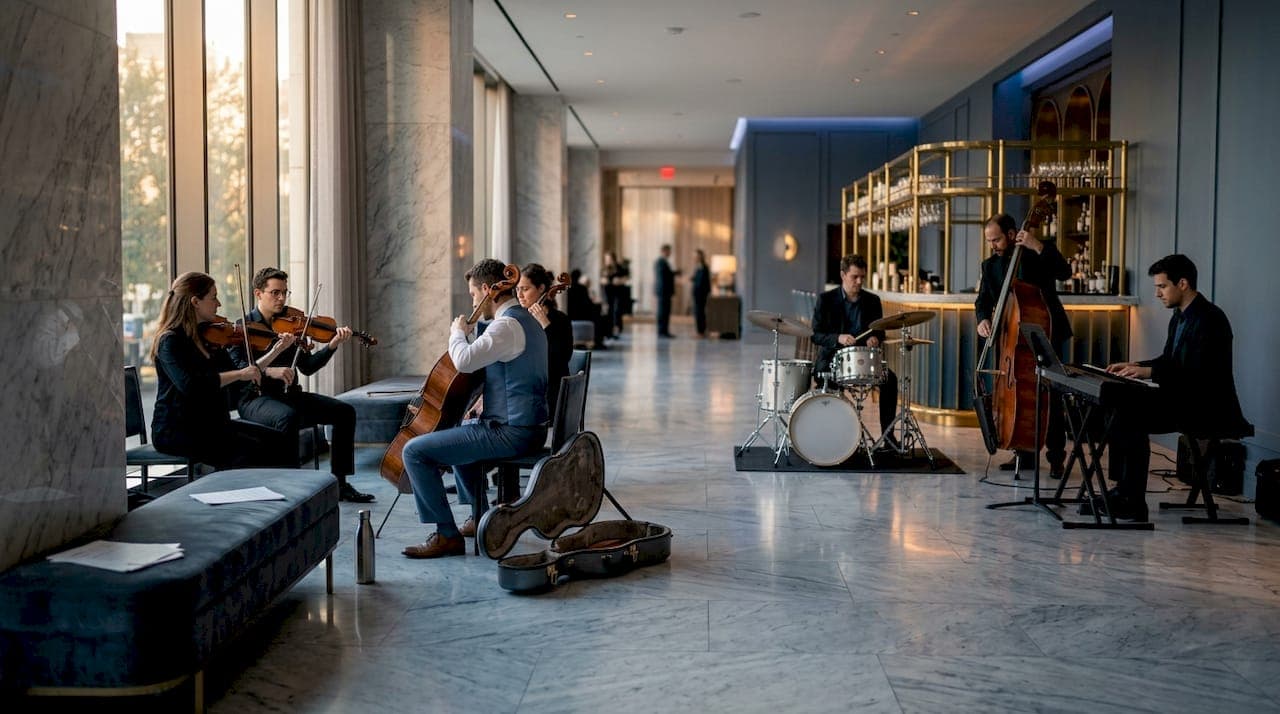
Choosing live music for your wedding sounds exciting until you realize how much the decision actually matters. The string quartet vs jazz trio wedding debate comes up constantly among couples and planners, and for good reason. Each ensemble creates a completely different experience, affects your venue logistics, and lands in a different part of your budget. Before you commit to either option, you need to understand exactly what you're getting, not just the sound, but the setup, the atmosphere, and the practical reality of each on your actual wedding day.
Table of Contents
- Key takeaways
- String quartet vs jazz trio wedding: what you're actually comparing
- Space, setup, and venue logistics
- What each ensemble actually costs
- Matching the ensemble to your wedding atmosphere
- My honest take after years in live wedding music
- Find the right ensemble with Alexlevinmusic
- FAQ
Key takeaways
| Point | Details |
|---|---|
| Sound character differs sharply | String quartets deliver rich, formal harmonies while jazz trios bring rhythmic warmth and flexibility. |
| Space requirements vary | A string quartet needs roughly 2m x 3m of floor space; a jazz trio fits into a tighter 2m x 2.5m footprint. |
| Budget ranges overlap | Both ensembles can range from $1,000 to $2,200 depending on duration, travel, and customization. |
| Atmosphere drives the choice | Formal ceremonies favor string quartets; relaxed cocktail hours and receptions favor jazz trios. |
| Logistics matter as much as sound | Power access, flat flooring, and lighting all influence which ensemble works for your specific venue. |
String quartet vs jazz trio wedding: what you're actually comparing
These are not just two different sounds. They are two different musical philosophies, and understanding that distinction makes every other decision easier.
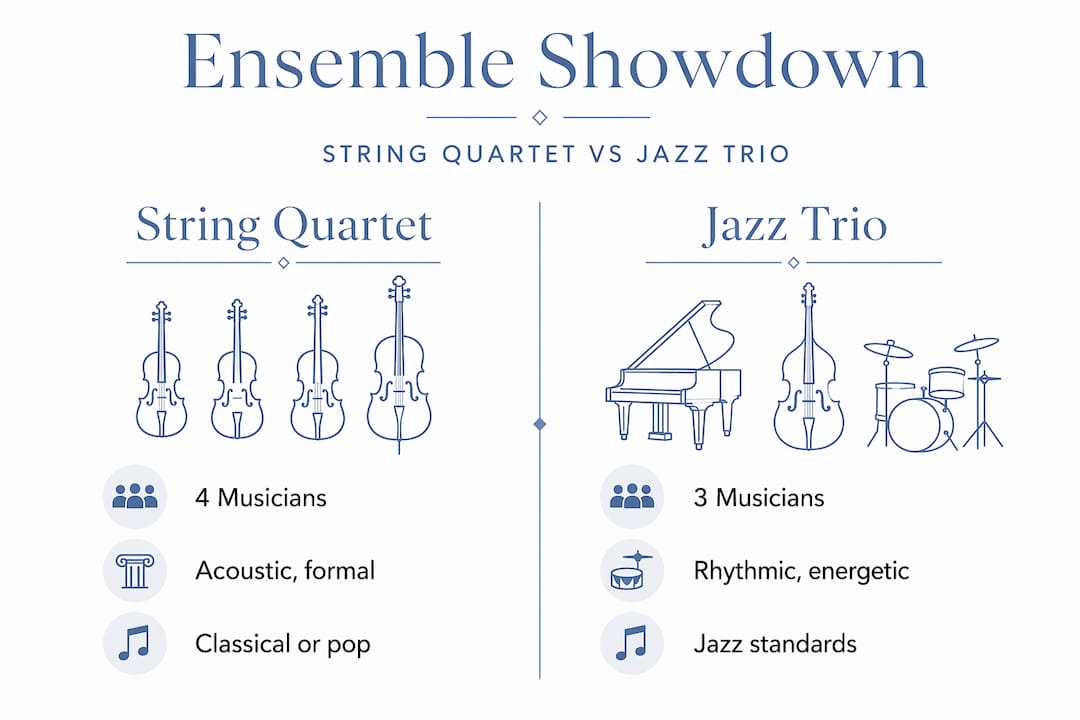
A string quartet is exactly what it sounds like: two violins, a viola, and a cello. The four-part acoustic arrangement produces a sound that is full, layered, and genuinely self-contained. No amplification required in most indoor settings. String quartets offer a richer, fuller sound with rich harmonies that naturally fill a room with warmth and formality. Repertoire typically spans classical compositions, Baroque standards, and modern crossover material. String quartets can cover pop, film, and game music, including the kind of Bridgerton-style arrangements that have become wildly popular at recent weddings.
A jazz trio is typically built around piano, upright bass, and drums. Some groups swap in a guitarist or add a vocalist. The configuration is more flexible than a quartet, but the core sound is always rhythmic and conversational. Jazz trios often include piano, bass, and drums with options for vocals, covering jazz standards, blues, Latin tunes, and smooth contemporary pieces. That diversity in programming is one of the trio's real strengths. A skilled trio can move from a Sinatra ballad to a Brazilian bossa nova without missing a beat.
Here is a direct comparison to frame the core differences:
| Feature | String quartet | Jazz trio |
|---|---|---|
| Musicians | 4 (2 violins, viola, cello) | 3 (piano, bass, drums or similar) |
| Sound character | Rich, formal, harmonically dense | Warm, rhythmic, conversational |
| Amplification | Usually not needed indoors | Often needs some amplification |
| Repertoire | Classical, crossover, pop arrangements | Jazz, blues, swing, Latin, standards |
| Volume level | Moderate, controlled | Variable, can be louder |
| Ambiance | Elegant and ceremonial | Relaxed and inviting |
One thing that surprises couples: the difference in jazz trio vs quartet sound quality is not about one being better. It is about the emotional register each creates. Strings feel like you are in a European palace. Jazz feels like you are in a candlelit supper club. Both are beautiful. They just tell different stories.
Space, setup, and venue logistics
This section often gets ignored until someone is standing in a venue with a tape measure and a problem. Do not let that be you.
A string quartet needs room for four musicians, four chairs, four music stands, and the physical space to bow freely. String quartets typically require around 2m x 3m of space, which is roughly the size of a small dining table. A jazz trio fits into a more compact setup, closer to 2m x 2.5m, though a full acoustic piano changes that calculation entirely if your venue does not already have one in place.
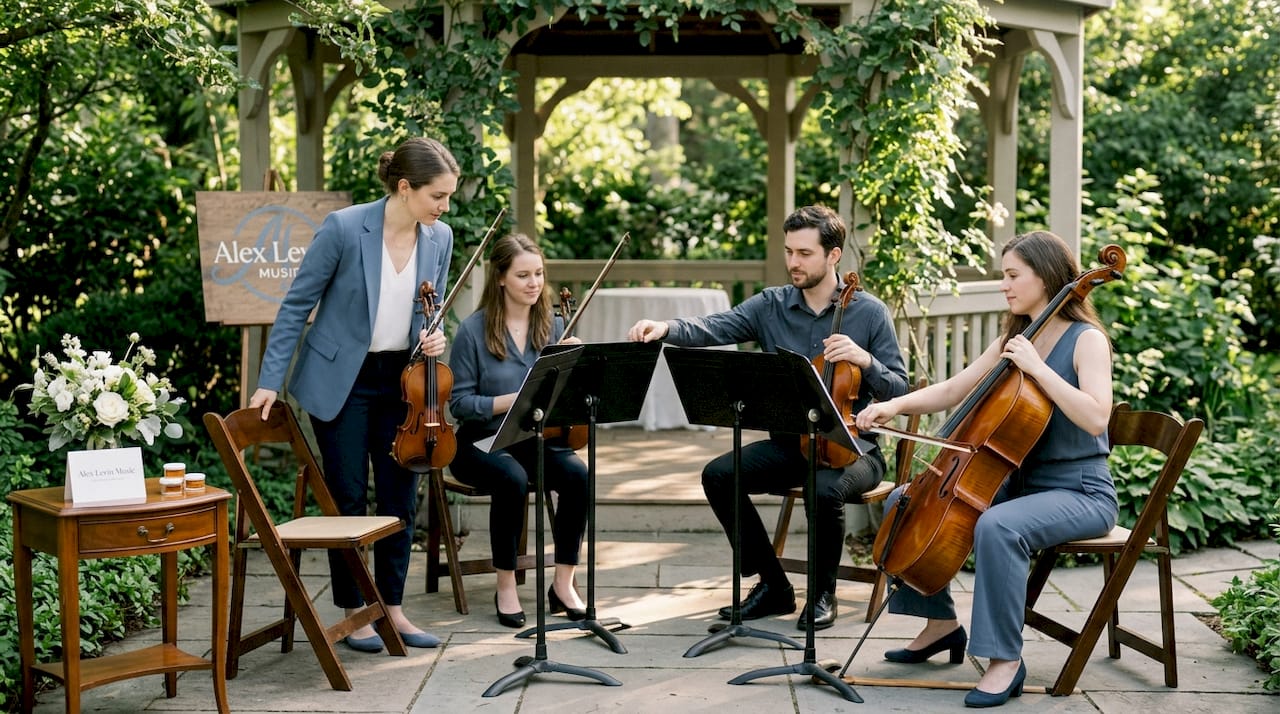
There is more to it than square footage. Practical setup factors like floor surface and lighting affect which ensemble works for your space. String players need flat, stable ground for their chairs and stands. They also need good lighting to read sheet music, which matters more than most couples realize for outdoor daytime events with shifting sun angles or dimly lit evening venues.
Jazz trios, especially those using electric keyboards instead of acoustic grands, tend to be more adaptable. They can run off standard power outlets and fit into tighter corners. However, if your venue does not have strong acoustics, a jazz trio will need a PA system and potentially a sound technician.
- String quartets: acoustically self-sufficient indoors, require flat flooring and consistent lighting, cannot easily perform in high-wind outdoor settings
- Jazz trios: need access to power, may require a PA system, more adaptable to irregular spaces and venues without existing instruments
Pro Tip: If you are planning an outdoor ceremony, ask your musician specifically about wind and direct sunlight. Bowed string instruments and loose sheet music do not mix well with a breeze. A jazz trio with digital sheet music and a keyboard may have an easier time.
What each ensemble actually costs
Let's be direct about money. Live wedding music is an investment, and the price spread between ensembles is real.
Jazz trio entertainment typically starts around $1,000 and averages around $2,000 for live wedding performances. String quartets run a comparable range. String trios for ceremony and drinks reception start around £1,100 to £1,500, with full-day quartet bookings reaching £1,800 to £2,200 in the UK market. When converted and adjusted for the US market, both ensembles generally land in the $900 to $2,200 range depending on duration, location, and the musicians' experience level.
| Cost factor | String quartet | Jazz trio |
|---|---|---|
| Base starting price | ~$1,000 to $1,500 | ~$1,000 to $2,000 |
| Travel fees | Yes, especially outside metro areas | Yes, comparable |
| Customization fees | Often small charge per special request | Usually included in standard quote |
| Equipment rental | Rarely needed | May need piano rental or PA system |
| Full-day premium | Increases significantly with 4 musicians | Slightly lower than quartet overall |
The real cost difference shows up at scale. A quartet has four musicians to pay. A trio has three. That gap narrows when you factor in equipment costs for jazz groups, but it still influences the final number. Jazz trios work well for smaller budget events without sacrificing quality, which makes them a strong choice when you want live music throughout the reception without breaking the budget.
Pro Tip: Ask for a per-hour rate and a package rate when getting quotes. Most ensembles offer better value on two to three hour packages than on hourly billing, especially if you need music across multiple wedding phases like the ceremony, cocktail hour, and the start of dinner.
Matching the ensemble to your wedding atmosphere
This is where most planning guides stop at obvious advice. Here is something more useful: think in phases, not in the whole day.
A string quartet builds ceremony presence. Guests walking into the venue hear those four instruments playing something like Pachelbel's Canon or a string arrangement of a couple's favorite song, and it signals that something meaningful is about to happen. String quartets suit larger gatherings where ambient noise is higher and a fuller sound needs to carry across the room. That is specifically why they work so well for ceremonies with 100 or more guests seated in a formal space.
A jazz trio creates social permission. When guests arrive at a cocktail hour and hear a trio playing Fly Me to the Moon or a swinging arrangement of a current hit, they relax. They talk. They move toward the bar. That is not an accident. The rhythmic looseness of jazz does something to a crowd that classical music simply does not. If your reception is meant to feel like a party with great taste rather than a formal dinner, the trio wins that phase.
Some couples solve the debate by using both:
- String quartet for the ceremony processional, ceremony music, and recessional
- Jazz trio for the cocktail hour and early reception
- DJ or band for dancing later in the evening
This phased approach to live wedding music lets you use each ensemble exactly where it performs best. It does cost more, but it produces a wedding where every phase has its own sound identity.
The swing band vs jazz trio question also comes up for receptions where dancing is expected. A standard jazz trio is better suited to background and light social music. If you want guests on the floor for extended dancing, a swing band or a larger jazz ensemble with a horn section will have the energy to sustain that.
My honest take after years in live wedding music
I have watched couples agonize over this decision when the real answer was already in front of them. Ask yourself who your guests are, not who you wish they were.
If your crowd is mostly over 50 and the venue has marble floors and crystal chandeliers, the string quartet is going to fit like it belongs there. If your crowd is 30 and 40-somethings who want a great evening out that happens to be your wedding, the jazz trio will read the room better. Neither ensemble is formally superior. They just appeal to different guest demographics and different venue energies.
What I have noticed more than anything is that professionalism and adaptability matter as much as the ensemble type. A highly skilled jazz trio that takes requests, reads the room, and adjusts volume without being asked will create a better experience than an average string quartet playing the same program mechanically. Choosing the right musician for your event style means looking past the format and evaluating the actual performers.
I also encourage couples to stop treating the music as decoration. The music is the atmosphere. Everything guests feel in those hours comes partly from what they are hearing. Budget accordingly. A live ensemble is worth stretching for if it means the difference between a beautiful evening and an extraordinary one.
— Alex
Find the right ensemble with Alexlevinmusic
If you are still weighing your options after reading this, the next step is simple: hear the musicians before you book them.
Alexlevinmusic serves couples and planners across Philadelphia, New York, and beyond with professional jazz trios, string quartets, solo piano, and full wedding band options. Every ensemble is customizable, whether you need a single classical piece for your processional or a full jazz program that carries your cocktail hour through dinner. You can explore the full range of wedding ensembles and soloists to hear what each format sounds like in a real setting, or go directly to the reception music page if you are focused on the party side of your evening. The site includes video samples, booking contacts, and detailed descriptions of each offering. Reach out early. The best ensembles book months in advance, and knowing what you want before your venue is finalized gives you real flexibility.
FAQ
What is the main difference between a jazz trio and a string quartet for weddings?
A string quartet provides formal, acoustic richness suited for ceremonies and elegant receptions, while a jazz trio delivers rhythmic warmth and a more relaxed social energy ideal for cocktail hours and casual receptions.
Which ensemble is better for an outdoor wedding?
A jazz trio with a keyboard and PA system generally handles outdoor settings more reliably than a string quartet, which is sensitive to wind, uneven ground, and variable lighting conditions.
How much does a jazz trio cost compared to a string quartet?
Both typically range from around $1,000 to $2,200 depending on duration, location, and experience level. Jazz trios start around $1,000, while string quartets may cost slightly more for full-day events due to the additional musician.
Can a string quartet play modern songs, not just classical music?
Yes. String quartets perform pop, film, and crossover arrangements alongside classical repertoire, and most accept custom song requests for a small additional fee.
Is it worth hiring both a string quartet and a jazz trio for one wedding?
If your budget allows it, using a string quartet for the ceremony and a jazz trio for the cocktail hour creates a distinct sound identity for each phase and consistently produces strong guest reactions.
Recommended
- Creating Memorable Moments: The Impact of Personalized Jazz Music at Your Wedding | Alex Levin Music | Live Wedding Music Philadelphia | Live Event Music Philadelphia
- The Magic of Live Jazz at Your Wedding: Why It’s a Must-Have | Alex Levin Music | Live Wedding Music Philadelphia | Live Event Music Philadelphia
- Sophisticated Sounds: Selecting the Perfect Jazz Ensemble for Corporate Events | Alex Levin Music | Live Wedding Music Philadelphia | Live Event Music Philadelphia
- Elevate Your Wedding Day with Enchanting Jazz: Why a Live Band is a Must-Have in NYC | Alex Levin Music | Live Wedding Music Philadelphia | Live Event Music Philadelphia