
A corporate setlist is defined as a purposefully ordered sequence of songs designed to match the mood, audience, and objectives of a business event. Unlike a concert setlist built around artistic expression alone, a corporate setlist functions as an event management tool. It controls energy, signals transitions, and shapes how guests feel at every stage of the evening. Understanding how musicians tailor corporate setlists gives event planners a real advantage when booking and briefing live entertainment.
The industry term for this practice is setlist architecture, and professional musicians treat it with the same rigor that event planners apply to room layout or catering flow. Alexlevinmusic, which specializes in jazz, swing, and sophisticated live performance for corporate gatherings in Philadelphia, New York, and beyond, builds every setlist around three core variables: the event's phase structure, the audience's demographic profile, and the venue's acoustic character.
How musicians tailor corporate setlists: the key factors
The starting point for any corporate setlist is the audience. Age range, cultural background, and musical familiarity all determine which songs will land and which will create awkward silence. A gala for a financial firm skews toward classic jazz standards and Motown. A tech company holiday party may call for upbeat pop and funk. Getting this wrong is the most common setlist mistake, and it is entirely avoidable with a pre-event briefing.

Event type shapes the setlist just as much as audience demographics. The objectives of a cocktail reception differ sharply from those of an awards ceremony or a product launch. A cocktail hour calls for background-level sophistication that encourages conversation. An awards ceremony needs music that punctuates moments without competing with the program. A dance-focused holiday party demands a completely different energy arc. Knowing the event format before building the setlist is non-negotiable.
Venue size and acoustics also drive song selection. A string quartet in a 200-person ballroom creates a different sonic experience than the same ensemble in a 40-person boardroom. Larger rooms require songs with clear melodic lines that carry across distance. Smaller, more intimate spaces reward nuanced arrangements and quieter dynamics.
The remaining factors musicians weigh include:
- Set length and timing. Professional musicians plan 13 songs instead of 15 to allow for soundcheck flexibility and real-time adjustments. That buffer prevents the set from running long during a tightly scheduled event.
- Energy management. A well-built setlist balances upbeat, mid-tempo, and slower songs so the audience never feels fatigued or disengaged.
- Client preferences vs. musician recommendations. Planners know the audience; musicians know what works on a stage. The best setlists come from combining both perspectives.
Pro Tip: Ask your musician for a sample setlist from a comparable past event. It tells you more about their approach than any verbal description.
How is a corporate event setlist structured?
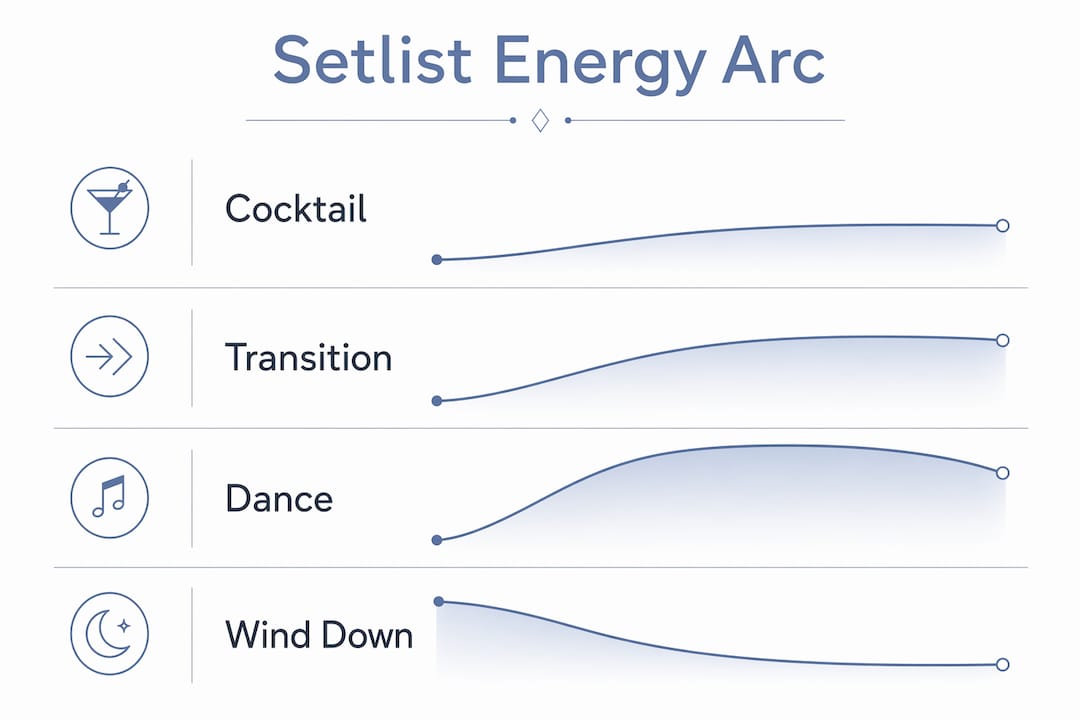
A professional corporate setlist follows a four-phase arc that mirrors the natural energy flow of the event itself. Each phase serves a distinct function, and the transitions between them are as important as the songs within them.
- Cocktail or dinner phase. This phase calls for sophisticated, mid-tempo material that sets the tone without demanding attention. Jazz standards, bossa nova, and lightly arranged pop work well here. The goal is to create an atmosphere, not a performance.
- Transition phase. As dinner winds down and guests shift into a more social mode, the music lifts slightly in energy. This is where the musician introduces more recognizable material. Placing major hits strategically as emotional payoffs rather than opening with them keeps the audience engaged longer.
- Dance floor phase. This is the highest-energy section of the set. Upbeat songs, strong grooves, and crowd-familiar material drive participation. The musician's job here is to read the room and sustain momentum without burning out the audience too early.
- Closing phase. The final songs should bring the energy down gracefully. A strong closer leaves guests with a positive emotional memory of the event. Abrupt endings or songs that feel mismatched to the moment undercut everything that came before.
Within this arc, slower or stripped-down songs serve a specific purpose. They give the audience breathing space and prevent the set from feeling relentless. Think of them as reset points that make the high-energy moments hit harder by contrast.
Technical logistics also shape the structure. Grouping songs by guitar tuning or key minimizes the pauses between songs and keeps momentum intact. When a tuning change is unavoidable, experienced musicians fill the gap with a brief story, a crowd interaction moment, or a short instrumental passage. Unplanned pauses are where audience attention slips away.
Pro Tip: Request that your musician print the setlist with BPM, key, and duration for each song. It makes coordinating event transitions with your event timeline far easier.
How do musicians use audience data to customize setlists?
Data has changed how professional musicians approach setlist customization. Streaming metrics, ticketing data, and social media signals now allow musicians to identify which songs resonate with specific audience types before the event begins. A musician who performs regularly for corporate clients in a particular industry or city can analyze what their audiences respond to and build accordingly.
The practical application for corporate events looks like this:
- Pre-event surveys. A short questionnaire sent to the client or event committee identifies must-play songs, genres to avoid, and any cultural sensitivities. This takes 10 minutes and eliminates the most common setlist conflicts.
- Social engagement signals. Crowd reaction metrics such as singalong volume and social posts from past events guide ongoing setlist refinements. Musicians who track this data build better setlists over time.
- Balancing hits and rarities. Hits create instant recognition and unity; rarities build a sense of exclusivity for guests who know the music deeply. For corporate events, the ratio typically favors familiar material, but a well-placed unexpected song can become the most talked-about moment of the night.
- Real-time adaptation. Experienced musicians read the room during the performance and adjust. If the dance floor fills early, they extend the high-energy phase. If the crowd is quieter than expected, they pull back and rebuild gradually.
Data analytics inform the setlist, but they do not replace musician intuition. Artist identity and live judgment remain the deciding factors when data and instinct conflict. The best corporate performances feel personal, not algorithmic.
Short-form video content has also become a useful signal. Musicians who track how high-energy short sets perform on social platforms gain real insight into which songs generate the strongest audience response, and that data feeds directly back into setlist decisions for live events.
What can event planners do to collaborate on setlists?
Event planners who treat setlist collaboration as a logistics task get better results than those who leave it entirely to the musician. The planner holds critical information the musician cannot access alone: the guest list composition, the event timeline, the key moments that need musical support, and the client's expectations.
Effective collaboration starts before the booking is finalized. When you choose the right musician for your event, confirm that they offer setlist consultation as part of their service. Most professional musicians do, but the depth of that consultation varies widely.
The most productive briefing covers these points:
- Event goals and audience profile. Share the guest demographics, the company culture, and any specific moments the music needs to support.
- Mood shifts and timeline. Walk the musician through the event schedule and identify where the energy should rise, hold steady, or drop.
- Set length and flexibility. Confirm the total performance time and whether the musician can extend or cut the set if the event runs long or short.
- Thematic preferences. If the event has a theme, such as a 1920s gala or a Latin-inspired company celebration, the setlist should reflect it.
- Contingency planning. Keeping bench songs ready for encores and adapting the final songs based on room energy is standard practice for experienced musicians. Confirm this flexibility is built into your agreement.
Striking the right tone between formal and fun is the central challenge of corporate event music. The setlist is the primary tool for navigating that balance. Planners who communicate clearly and trust the musician's expertise on pacing and song choice consistently report better outcomes than those who micromanage the song selection.
Pro Tip: Send the musician a one-page event brief covering audience age range, event format, key moments, and any songs to avoid. It takes 15 minutes to write and saves hours of back-and-forth.
Key Takeaways
A corporate setlist works best when it follows a four-phase energy arc, incorporates audience data, and stays flexible enough to adapt to real-time crowd signals.
| Point | Details |
|---|---|
| Four-phase arc | Structure every corporate set across cocktail, transition, dance, and closing phases for consistent energy flow. |
| Strategic hit placement | Place recognizable songs as emotional payoffs mid-set, not at the opening, to sustain audience engagement longer. |
| Technical grouping | Group songs by key or tuning to minimize pauses and keep the set's momentum intact throughout the performance. |
| Data-informed customization | Use pre-event surveys, streaming signals, and past crowd reactions to select songs that fit the specific audience. |
| Planner-musician collaboration | Share a one-page event brief covering audience profile, timeline, and key moments before the musician builds the setlist. |
What I've learned about corporate setlists that most planners don't expect
The most common misconception I encounter is that corporate clients want safe, predictable music. They say they want background music, but what they actually respond to is music that feels considered. When a setlist moves through a clear arc and the songs feel chosen rather than shuffled, guests notice. They may not articulate it, but the energy in the room is different.
The second thing I've learned is that the opener matters more than almost any other song in the set. Most setlists fail because of a wrong opener, a mid-set energy sag, or poor timing. A strong opener sets the audience's expectations for everything that follows. At a corporate event, that opener also signals to the client that you understood the brief.
I also push back gently on planners who want to lock in every song weeks in advance. A setlist is a plan, not a contract. The best performances I've given were ones where I had a solid structure but the freedom to read the room and adjust the last three songs based on what the crowd was actually doing. That flexibility is what separates a live performance from a playlist. Planners who understand that distinction get the most out of their music investment.
— Alex
Live music for your next corporate event, tailored to your audience
Alexlevinmusic brings the same setlist discipline to every corporate engagement, from intimate boardroom receptions to large-scale galas. Every performance begins with a consultation that covers your event timeline, guest profile, and the specific moments you want the music to support.
Whether you need a jazz trio for a cocktail hour, a full band for a holiday party, or a solo pianist for an awards dinner, Alexlevinmusic builds a setlist that fits the event rather than a generic one that merely fills the time. Live music at corporate events creates the kind of shared experience that a playlist simply cannot replicate. Explore the full range of corporate event music services and find the right format for your next event.
FAQ
What is a corporate setlist?
A corporate setlist is an ordered sequence of songs selected and arranged to match the mood, audience, and phase structure of a business event. It functions as an event management tool, not just a song list.
How long should a corporate event set be?
Most corporate sets run between 45 and 90 minutes depending on the event format. Professional musicians typically plan 13 songs per set to allow for real-time adjustments without running over schedule.
How do musicians adapt setlists during a live performance?
Experienced musicians read crowd energy signals such as dance floor activity, conversation volume, and audience body language, then adjust the final songs in the set to match the room's actual mood.
What information should I give a musician before the event?
Share the guest demographics, event timeline, key moments that need musical support, preferred genres, and any songs to avoid. A one-page brief covers everything a musician needs to build an effective setlist.
Why does song order matter in a corporate setlist?
Song order controls the emotional arc of the event. Placing hits too early flattens the set's momentum, while a well-sequenced arc builds energy gradually and leaves guests with a strong final impression.