
Music is the single most powerful tool for shaping how guests feel at any event. Before the first drink is poured or the first conversation starts, the music playing in the room has already told every guest what kind of night this will be. How music sets party atmosphere is not a matter of taste alone. It is a function of tempo, genre, volume, sequencing, and whether the performance is live or recorded. This guide gives event organizers and hosts a practical framework for making music work as hard as every other element of their event planning.
How does music set party atmosphere from the moment guests arrive?
Music shapes mood through a direct biological mechanism. Shared music triggers dopamine release and synchronizes brainwaves across groups, producing what sociologists call collective effervescence. That is the feeling of being part of something larger than yourself. It explains why a room full of strangers can feel like a community within minutes of the right song starting.

The emotional impact of music outlasts almost every other event element. Guests forget decorations but remember the song that made them want to dance, or the melody that made them tear up during a toast. That memory is not accidental. It is the result of music activating the brain's reward and emotional centers simultaneously. For hosts, this means music deserves the same planning attention as catering or venue selection.
Music also reduces social friction by filling silence, easing nervousness, and giving guests a shared sensory experience to react to. A quiet room forces conversation. A well-chosen soundtrack invites it.
How do music styles and tempos shape party energy?
Genre and tempo are the two levers hosts control most directly. Upbeat rhythms increase guest enthusiasm and sociability, while slower tempos encourage relaxation and conversation. That is not a preference. It is a measurable behavioral response.
Here is how specific music characteristics translate into atmosphere:
- High-BPM tracks (120+ beats per minute): Energize the room, pull guests onto the dance floor, and signal that the party has shifted into full gear. Genres like funk, pop, and upbeat swing work here.
- Mid-tempo tracks (80–110 BPM): Create a social, conversational energy. Guests stay engaged without feeling pressured to dance. Jazz standards and soul fit this range well.
- Slow tempos (under 80 BPM): Promote intimacy and winding down. Classical pieces, ballads, and ambient jazz work for cocktail hours or event closings.
- Volume levels: Loud music signals energy and excitement. Lower volumes allow conversation to dominate. The right volume depends on the event phase, not personal preference.
- Sound quality: Poor audio makes even great music feel cheap. Crisp, balanced sound reinforces the professionalism of the entire event.
Pro Tip: Start 10–15 BPM lower than your target energy level when guests first arrive. Let the music build naturally as the room fills. Guests who arrive to an already-peak playlist have nowhere to go emotionally.
For hosts planning events with specific cultural or thematic requirements, choosing the right music genre by audience and event type is the most direct path to a cohesive atmosphere.
How do you read a crowd and adapt music in real time?
Reading crowd energy is a skill built on observation, not guessing. Non-verbal cues like body language and proximity tell you more about how a room feels than any pre-planned setlist. A host or performer who watches the room can prevent energy drops before they happen.
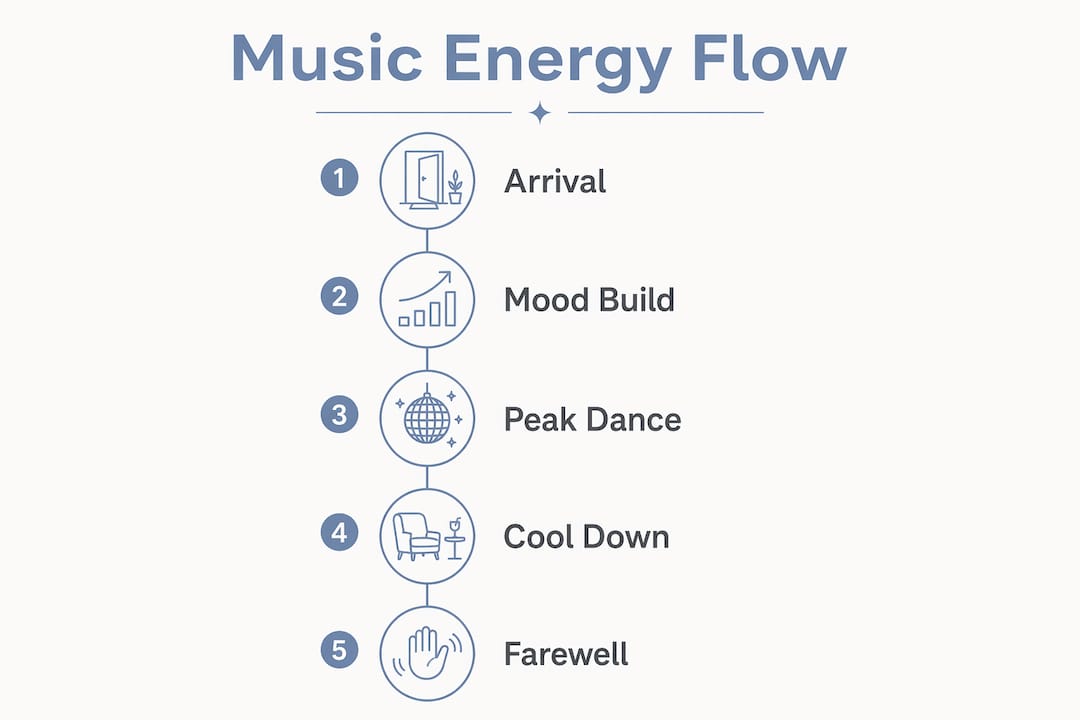
The most effective approach follows a structured energy arc:
- Build: Open with familiar, mid-energy music that welcomes guests without overwhelming them. The goal is comfort and arrival, not peak excitement.
- Peak: Introduce higher-energy tracks as the room fills and guests settle in. This is where dancing begins and social energy reaches its highest point.
- Release: Drop the intensity briefly. A slower song or a quieter moment gives guests a chance to breathe, hydrate, and connect in smaller groups.
- Rebuild: Bring the energy back up after the release. Guests who have rested are ready to re-engage, often with more enthusiasm than before.
- Climax: The highest-energy moment of the night. Reserve your most crowd-pleasing tracks for this point.
- Wind-down: Close with slower, warmer music that signals the event is ending without cutting the mood abruptly.
Structured energy arcs improve atmosphere continuity and keep guests engaged across the full duration of an event. Without this structure, even a great playlist can feel flat or disjointed.
Pivot strategies matter too. If the dance floor empties, do not keep playing the same style louder. Drop to a crowd-pleasing classic, reduce the tempo by 10–15 BPM, or shift genres entirely. The goal is re-engagement, not persistence.
Pro Tip: Build two or three alternative playlist branches before the event. One for a crowd that wants to dance early, one for a crowd that stays conversational longer, and one for mixed-age groups. Switching between them in real time is far easier than rebuilding a setlist on the fly.
Live music vs. playlists: which creates a better party atmosphere?
Live music and recorded playlists serve different functions, and the difference in guest experience is significant. Live musicians add spontaneity and direct interaction that no playlist can replicate. A performer reads the room, adjusts tempo mid-song, and responds to crowd energy in ways that a static recording cannot.
The trend data confirms this. Inquiries for specialized live acts doubled in the 12 months leading into 2026, reflecting a clear shift in what hosts and guests expect from celebrations. That growth is not driven by nostalgia. It is driven by the experience gap between a live performance and a speaker playing a Spotify queue.
| Feature | Live music | Recorded playlist |
|---|---|---|
| Real-time crowd response | Yes, performers adjust instantly | No, fixed track order |
| Guest interaction | Direct, personal, memorable | Passive listening only |
| Emotional impact | High, amplified by human presence | Moderate, depends on track selection |
| Flexibility | Can extend, shorten, or shift genre mid-set | Requires manual intervention |
| Cost | Higher investment | Lower upfront cost |
| Atmosphere uniqueness | One-of-a-kind performance | Replicable by any host |
The right choice depends on budget, event type, and the atmosphere you want guests to remember. For weddings, milestone birthdays, and corporate events where impression matters, live music consistently outperforms a playlist on guest satisfaction and memory formation. For casual backyard gatherings, a well-curated playlist with a strong energy arc delivers solid results at lower cost.
Alexlevinmusic specializes in live performances for weddings and events across Philadelphia, New York, and beyond, offering jazz trios, string quartets, solo piano, and DJ services tailored to the event's specific mood and guest profile.
Practical tips for sequencing music to create a great party atmosphere
Music selection and sequencing are two separate skills. A host can have excellent taste in music and still create a disjointed experience by ordering tracks poorly. The following principles apply across event types and genres.
- Match the opening to the arrival energy. Guests walk in cautiously. Soft jazz, acoustic pop, or ambient instrumental music gives them space to settle without demanding immediate participation.
- Avoid abrupt energy shifts. Moving from a slow ballad directly into a high-BPM dance track breaks the emotional flow. Transition through a mid-tempo bridge track instead.
- Incorporate guest preferences early. Survey guests or review the host's input before the event. Weaving in one or two crowd favorites early builds trust and signals that the music was chosen for them specifically.
- Use signature moments strategically. A surprise song, a live cover of a meaningful track, or a genre shift at the right moment creates a memory anchor. Guests talk about these moments for years.
- Account for cultural context. A corporate event in Philadelphia calls for different music choices than a private birthday celebration in New York. Genre, language, and tempo all carry cultural signals that affect guest comfort.
- Plan the close as carefully as the peak. The last 20–30 minutes of music shape the final impression guests carry home. Warm, familiar, lower-energy tracks close an event gracefully.
For hosts managing events that move from dinner to dancing, music planning for private events requires a clear phase structure so the transition feels natural rather than forced.
The role of music at birthday parties follows the same arc principles but with a stronger emphasis on personal significance. Milestone birthdays benefit from music that spans the guest of honor's life, creating emotional resonance across different age groups in the room.
Key Takeaways
Music is the primary driver of party atmosphere because it shapes guest emotion, social behavior, and memory formation from the first moment guests arrive to the final song of the night.
| Point | Details |
|---|---|
| Music triggers immediate mood shifts | Dopamine release and brainwave synchronization happen within seconds of music starting. |
| Tempo controls energy level | High-BPM tracks energize; slow tempos relax. Match BPM to the event phase, not personal preference. |
| Energy arcs prevent flat events | Structure music in six phases: build, peak, release, rebuild, climax, and wind-down. |
| Live music outperforms playlists | Live performers adjust in real time, creating unique guest experiences playlists cannot match. |
| Sequencing matters as much as selection | Abrupt genre or tempo shifts break atmosphere. Use bridge tracks to transition between energy levels. |
Why I think most hosts get music wrong
Most hosts treat music as a background detail. They finalize the venue, the catering, and the decor, then add a playlist as an afterthought. That is the single biggest mistake in event planning, and I have seen it play out at every level of celebration.
The guests who leave a party saying "that was incredible" are almost never talking about the food. They are talking about the moment the room came alive. That moment is always a music moment. It is the song that pulled everyone onto the floor, or the live performer who made eye contact with a guest during a solo and turned a stranger into a participant.
What I have learned from years of performing at weddings, corporate events, and private celebrations is that personalized live music creates a fundamentally different guest experience than any playlist. A playlist plays at people. A live musician plays with them. That distinction sounds small. The difference in the room is enormous.
Hosts who prioritize music early in their planning process consistently produce better events. Not because they spend more money, but because they think about the emotional arc of the night before they think about the centerpieces. Start with the feeling you want guests to have at 10:00 PM, then build backward. The music plan writes itself from there.
— Alex
Live music for your next event from Alexlevinmusic
Planning an event where the atmosphere needs to land perfectly? Alexlevinmusic brings live jazz, swing, and sophisticated musical performances to weddings, corporate gatherings, and private celebrations across Philadelphia, New York, and beyond.
Every performance is customized to the event's theme, guest profile, and energy goals. Whether you need a jazz trio for a cocktail hour, a string quartet for a ceremony, or a full live band for a reception, Alexlevinmusic tailors the set to the moment. Explore what makes live music special and see how a professional live performance transforms the atmosphere of any celebration. Booking inquiries are welcome at alexlevinmusic.com.
FAQ
How does music affect the mood at a party?
Music triggers dopamine release and synchronizes emotional responses across a group, creating shared energy and social connection. The right tempo and genre can shift a room from quiet and reserved to energized and engaged within minutes.
What music genres work best for parties?
The best genre depends on the event type and guest profile. Upbeat funk, pop, and swing energize dance-focused events, while jazz standards and soul work well for cocktail hours and conversational gatherings.
Is live music worth the cost for a private party?
Live music consistently produces stronger guest memories and higher emotional impact than recorded playlists. Inquiries for specialized live acts doubled in the 12 months leading into 2026, reflecting how much hosts and guests value the live experience.
How do you transition music between event phases?
Use mid-tempo bridge tracks to move between energy levels. Jumping directly from a slow ballad to a high-BPM dance track breaks the emotional flow and can disengage guests rather than energize them.
When should you start planning music for an event?
Music planning should begin at the same time as venue and catering decisions. The emotional arc of the night depends on music sequencing, and that structure takes time to build correctly.