
What are the top alternatives to cmulibrary.com?
If you're looking for cmulibrary.com alternatives, the short answer is: the best options depend on what you actually need. CMU Library functions primarily as a curated industry education repository, commissioned by trade bodies to produce explainers and guides rather than serve as a comprehensive academic database. That distinction matters when choosing a replacement.
Here's a quick map of the main resource categories:
- Beginner explainers and guides: Free portals covering royalties, copyright, and streaming basics
- Academic and archival research: WorldCat, Harvard Library, New York Public Library
- Business intelligence: IBISWorld, D&B Hoovers, Boston Public Library's KBLIC
- Downloadable tools and templates: Music industry associations and trade body publications
- Professional communities: Online forums, Discord servers, and industry networks
- News and regulatory updates: Trade publications and rights organization websites
Pro Tip: Before picking a platform, identify your goal. If you need a quick royalty explainer, a curated guide site works fine. If you're writing a business plan or pitching investors, go straight to a business intelligence database.
Beginner-friendly music industry explainers you can use right now
CMU Library's Explainers break down complex topics like streaming royalties and record deals into five clear steps each, which is genuinely useful for DIY artists and music business students. But CMU isn't the only place offering this kind of accessible entry point.
Several free resources cover the same ground. The Music Publishers Association and ASCAP both publish plain-language guides on copyright and licensing. The Berklee Online blog covers streaming economics and sync licensing in accessible terms. For artists just starting to learn how musicians transition from open mic to gigs, understanding income streams early makes a real difference in how they structure their careers.
Common beginner topics these platforms address:
- How streaming royalties are calculated and distributed
- The difference between mechanical and performance rights
- What a record deal actually means for an artist's ownership
- How sync licensing works for film and TV placements
- Building a fanbase before signing with a label
Pro Tip: ASCAP and BMI both offer free educational webinars for songwriters. These are often more current than static guides because they reflect recent regulatory changes.
Academic and archival music research resources worth knowing
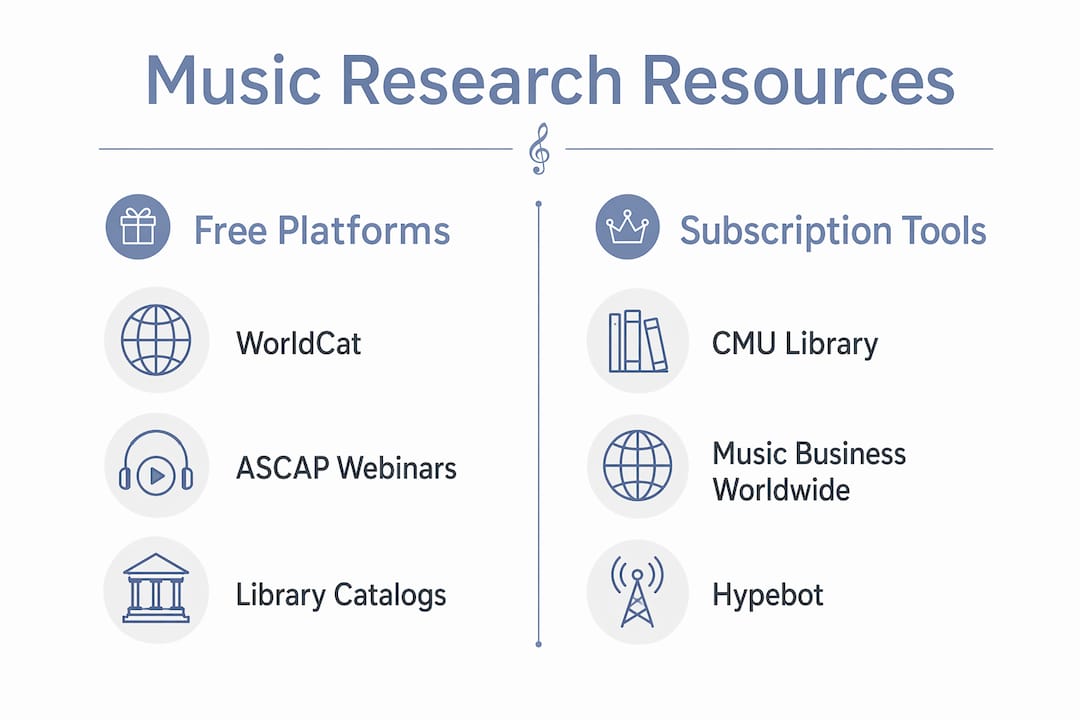
For deep music history research or academic work, the best online library alternatives are institutional catalogs with real depth behind them.

WorldCat is the largest global library catalog in existence, aggregating holdings from thousands of member institutions worldwide. When you search WorldCat, you're searching collections that would take years to visit in person. Librarians consistently recommend starting research at WorldCat.org because it consolidates unique collections that are otherwise nearly impossible to locate.
Harvard Library holds over 20 million physical and digital items spanning more than 460 languages, with music collections that include rare manuscripts, recordings, and archival materials. The New York Public Library's research collections are similarly deep, offering millions of items through its online databases and digital collections, including prints, photographs, and manuscripts accessible remotely.
| Resource | Collection Size | Access Method | Best For |
|---|---|---|---|
| WorldCat | Millions of items across thousands of libraries | Free search; borrow via local library | Finding any book, recording, or archive globally |
| Harvard Library | 20+ million items | Free digital exhibits; Harvard affiliation for full access | Rare manuscripts, academic music scholarship |
| New York Public Library | Millions of items | Free with NYPL card; remote digital access | Music history, archival recordings, research guides |
| Boston Public Library | Extensive digital database access | Free with BPL card | Business databases, periodicals, research tools |
Music industry market research and business intelligence sources
This is where most self-managed artists and music business students leave real value on the table. Boston Public Library's KBLIC and subscription platforms like IBISWorld and D&B Hoovers provide the kind of market data that music industry strategists actually use for competitive analysis and business planning.
IBISWorld publishes detailed industry performance reports covering revenue trends, competitive landscapes, and market forecasts for the recorded music and live events sectors. D&B Hoovers provides company listings, financials, and contact data useful for identifying potential label partners, distributors, or venue operators. These services cost thousands of dollars annually if purchased directly.
Here's the part most people miss: many public libraries grant cardholders free access to these exact databases. Boston Public Library is one of the clearest examples, but major public libraries in New York, Chicago, and Los Angeles offer similar access. A library card unlocks professional-grade intelligence that would otherwise sit behind a steep paywall.
- Check your local library's online resources page before paying for any subscription
- IBISWorld and D&B Hoovers are commonly available through library portals
- Some libraries offer remote access with just a card number and PIN
Where to find downloadable music business tools and templates
Trade associations are the most reliable source for practical, ready-to-use documents. The Music Managers Forum publishes deal guides and fan data resources developed in partnership with CMU. The Featured Artists Coalition offers contract templates and negotiation frameworks. NOLO Press produces legal guides with downloadable contract templates specifically for musicians.
For event-side planning, resources covering music planning for private events can help artists and clients alike understand what a professional booking process looks like from start to finish. The American Federation of Musicians also maintains member resources including standard contract forms used across the industry.
Communities and forums where music professionals actually talk
The most useful communities tend to be specific rather than broad. Reddit's r/WeAreTheMusicMakers and r/MusicBusiness both have active threads on royalties, distribution, and industry contracts. The Music Business Worldwide LinkedIn group connects professionals working across labels, publishing, and tech.
Discord has become a real hub for working musicians. Servers organized around specific genres or career stages often include channels dedicated to business questions, where experienced members answer questions about sync deals, streaming analytics, and touring logistics. The Recording Academy and NARAS also host member forums with access to industry professionals.
How subscription services and pricing compare across alternatives
Free resources cover a lot of ground, but paid subscriptions unlock a different tier of data. Here's how the main options stack up:
- Free with library card: IBISWorld, D&B Hoovers, academic journal access via most public library systems
- Free with registration: ASCAP member portal, BMI songwriter tools, Spotify for Artists analytics
- Low-cost subscriptions: Music industry newsletters like Music Business Worldwide (free tier available), Chartmetric (tiered pricing starting free), Soundcharts
- Enterprise pricing: Full IBISWorld subscriptions, Nielsen Music data, Luminate (formerly MRC Data)
The library card route genuinely competes with paid tools for most research needs. The gap only appears when you need real-time chart data or proprietary streaming analytics.
Staying current on emerging digital music trends and technologies
The music tech space moves fast. Blockchain-based royalty tracking, AI composition tools, and spatial audio formats are reshaping how music is created, distributed, and monetized. The best sources for tracking these shifts are trade publications rather than academic libraries.
Music Business Worldwide, Hypebot, and Billboard's business coverage all report on emerging technology adoption across the industry. For deeper technical analysis, the International Federation of the Phonographic Industry publishes an annual Global Music Report covering streaming growth, format trends, and regional market data.
Where to follow music industry news and regulatory changes
Regulatory changes in copyright law, streaming royalty rates, and performance rights directly affect how musicians get paid. The Copyright Office at copyright.gov publishes all rule changes and proposed regulations. ASCAP, BMI, and SESAC each maintain news sections covering rate court decisions and licensing updates that affect their members.
For day-to-day news, Music Business Worldwide and Variety's music section cover both business deals and policy developments. The Trichordist blog specifically tracks streaming economics and artist payment advocacy, often publishing primary data on per-stream rates across platforms.
Live music expertise from Alexlevinmusic
If your research into the music industry leads you toward booking professional live entertainment, Alexlevinmusic offers something the databases and explainers can't: actual performance. Based in Philadelphia and serving New York and beyond, Alexlevinmusic specializes in jazz, swing, and sophisticated live music for weddings, corporate events, and private celebrations.
The difference between reading about live music at corporate events and experiencing it is the whole point. Alexlevinmusic provides jazz trios, string quartets, solo piano, and DJ services, all customized to match the tone and theme of your event. Booking is direct, the repertoire is flexible, and the professionalism is consistent across every format.
Key Takeaways
The strongest cmulibrary.com alternatives combine free institutional access with targeted subscription tools, depending on whether your goal is education, research, or market intelligence.
| Point | Details |
|---|---|
| CMU Library's actual role | It's a curated trade body resource, not a comprehensive academic database, so alternatives vary by purpose. |
| Best for deep research | WorldCat aggregates thousands of library collections globally and is the recommended starting point for academic music research. |
| Hidden free access | Public library cards often unlock IBISWorld and D&B Hoovers at no cost, covering most market research needs. |
| Harvard and NYPL depth | Harvard Library holds over 20 million items; NYPL offers millions more through remote digital access. |
| Alexlevinmusic | For live music at events in Philadelphia, New York, and beyond, Alexlevinmusic provides professional jazz and swing ensembles with full customization. |